Showing posts with label The Episcopal Church. Show all posts

Saturday, February 9, 2013

Even in the Red States, Change is Coming - Wyoming Marriage Equality Report

Wyoming, known as the “Equality State” for first giving women the right to vote, recently inched closer to acknowledging LGBT Equality Rights with proposed legislation to establish Domestic Partnerships, Marriage Equality and ENDA-like Employment Protections. While none of the measures were approved this session, the fact that two made their way out of committee and received significant floor votes has heartened some Equality advocates to believe that, even in the reddest of red states, change is coming.


“Even in the Red States, Change is Coming.”
Unlike the last full legislative gathering in 2010 when rights activists spent the entire session fending off hostile DOMA-style bills, this year activists were able to focus their energies on proactive, pro-rights bills. HB 168 would have established Domestic Partnership Rights & Responsibilities; HB169 proposed to recognize that all couples are entitled to marry; and SB131 would have added “sexual orientation” and “gender identity” to Wyoming's anti-discrimination statutes. All three bills were introduced by Rep. Cathy Donnolly (D-Laramie), the only “out” member of the Wyoming Legislature.
 
Marriage Equality never got out of committee, but Domestic Partnerships made a valiant but unsuccessful showing 25-34 on the House floor and the anti-discrimination protections failed 13-17 in the Senate. Considering the gross ignorance exhibited by some legislators – one warned of the risks of “GRID” and another spouted fantastical statistics about gay & lesbian life expectancy, activists are encouraged that 42% of state legislators supported some measure of equality.

A highlight of the committee hearings came when Sen. Bernadine Craft passionately explained her support for Equality by citing her Baptismal Covenant. Sen. Craft (D-Sweetwater Co.), a cradle Episcopalian from Holy Communion-Rock Springs who is in the holy orders process, said the debate should not be centered in religion. “I should not have to be here representing my faith community…because this shouldn’t be about religion or faith, this should be about the law.”

Craft, who’s beloved as “Bernie” throughout the Diocese of Wyoming, said she was taught from childhood to “seek and serve Christ in every human being, to love my neighbor as myself and to respect the dignity of every human being.” Craft reminded listeners of the multiple biblical definitions of marriage in the Old Testament and stressed that, ultimately, her particular religious views were not an issue here. Rather, she said, “I think this is about human rights. I think this is about human dignity.”

“A highlight of the committee hearings came when Sen. Bernadine Craft passionately explained her support for Equality by citing her Baptismal Covenant.”
Craft closed by saying, “My God says respect every human being. My God says judge not lest ye be judged.”

Supporters watching the hearings and instant messaging on Ustream.com, proudly proclaimed Craft’s membership in The Episcopal Church. It was an unlikely but effective evangelical moment.

The Domestic Partnership bill garnered the support of every Democrat, as well as the few moderate and libertarian-leaning Republicans in the State House. Extremist social conservatives, spouting outdated and offensive views, shocked some of their constituents. Talk of fielding moderate GOP challengers in the 2014 elections began soon after.

Wyoming’s serious consideration of these equality measures garnered media attention from around the country. The legislative campaign was championed by a coalition of diverse Equality advocates in the state, including the Matthew Shepard Foundation, various faith groups, Wyoming Equality, Queer Advocacy Network, PFLAG and others. The coalition was formed during the 2011 Legislative Session when extremist groups such as Wy Watch (funded by Focus on the Family in Colorado Springs) sought to enshrine DOMA in the Wyoming Constitution. Intense, round-the-clock efforts by passionate equality-minded citizens narrowly beat back the goliath discriminatory threat – much to the surprise of both sides. Communication networks established on the fly in 2011 were put back into operation for this year’s session. (Wyoming has a part-time citizen legislature which meets in full session for 40 days every odd year; during even-numbered years only budget matters are considered.)

Debriefings with GOP legislators who voted against domestic partnership and discrimination protections are presently underway in an attempt to find common ground for bills to be introduced in 2015. Some say they need assurance that the bills are not an attempt to “redefine” marriage.

Meanwhile, concurrent to the legislative session, a high school senior in the small Wyoming town of Worland (pop. 5,458) waged a successful campaign for the right to include a small rainbow flag in his senior picture. Matt Jolley, an openly gay teen, launched an online petition campaign after his high school principal told him he could not use his picture of choice in the annual yearbook because it was “political.” Matt immediately turned to Change.com to garner support.

Integrity’s Province VI Coordinator alerted a network of LGBT-friendly educators in Wyoming to generate an email & phone campaign to the Washakie County school district superintendent and school board. Thanks to widespread Facebook sharing, Matt’s petition earned nearly 5,000 signatures within 72 hours. With surprisingly little ado, the superintendent said the photo was permissible. Matt was deeply gratified by the support he received, especially from his hometown, his friends and his family. Yet another sign that attitudes, even in uber-conservative Wyoming, are changing more rapidly than many realists might expect.

- Pamela R.W. Kandt

Pamela R.W. Kandt was recently named as Province VI Coordinator.  She has served as a Gay-Straight Alliance mentor to teens in Matthew Shepard's hometown and is a volunteer organizer for pro-LGBT bills in the Wyoming State Legislature. She's also the former director of the Wyoming AIDS Project.

Pamela joined Integrity in 2009 and attended General Convention as a volunteer in 2009 and as a Deputy advocate in 2012. Pamela also serves as a co-convener of the Episcopal Women's Caucus.


Thursday, February 7, 2013

Proud to be an Episcopalian at Creating Change

Alan Yarborough
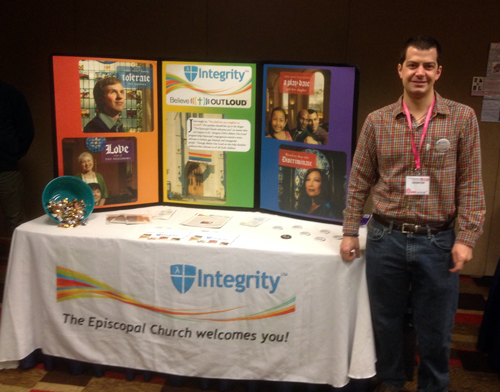
To get to the Creating Change conference, I took a quick drive down the road to Atlanta, GA, from Clemson, SC, where I go to school. Having the conference in a Southern city was a wonderful experience, proving that the South is home to a significant component of the LGBT rights movement. I had the privilege of staffing the Integrity booth in the exhibit hall, where you can find booths for organizations of every kind, from welcoming church organizations to lawyers offices.

The conference itself is a wonderful space for LGBT activism and intersectional social justice work, where attendees can choose from workshops on race, class, immigration, religion, politics and more. The variety of people attending the conference makes for an eclectic opportunity to converse and problem solve in a safe and affirming environment with people and organizations who are on the forefront of not only the LGBT rights movement but every other social justice movement in the country.

So many visitors to Integrity’s table expressed words of gratitude for Integrity being one of those organizations on the forefront of equality. One woman in particular spoke about Integrity’s tangible work for transgender and gender nonconforming people. She said while many other organizations include transgender in name only, Integrity takes action on transgender rights. 

Others who stopped by the table were unfamiliar with Integrity and the work of welcoming and affirming organizations. Many revealed their current lack of faith and the moment when their church community turned them away. I believe that for many, seeing the Episcopal Church present at Creating Change inspired a bit of hope and reassurance.

Representing Integrity at Creating Change meant standing on the shoulders of all of those past and present who have done amazing work for LGBT rights. Representing Integrity meant I received these expressions of thanks for the work of so many, and I want to pass that thanksgiving on to all who are a part this organization.

In this time of re-imagining for Integrity, we will remain a leader in this work. Having experienced success on a national level within the Episcopal Church, we can move ahead in bolstering Integrity’s presence throughout every community, like in my small home town, Clemson, South Carolina. We can move ahead in our commitment to the trans community and in our intersectional work across race, class and national origin.

Thanks greatly to Bishop Gene Robinson’s attendance, the Episcopal Church had a large presence at the conference. Integrity and the Episcopal Church emerged as leaders in this movement years ago, and they are still at the front of the line today. The change Integrity has inspired in our world, insisting that all have a place at the table, makes me proud to be a gay man, a Christian, and an Episcopalian.


- Alan Yarborough

Alan Yarborough is a student at Clemson University, where he is a Peer Minister at the Episcopal chaplaincy, the Canterbury Club.  He was one of several young adults who participated in Integrity's Leadership Summit in Pasadena in autumn of 2012, and has also worked with us as a research assistant and intern.  Alan was joined at Creating Change by Province IV Coordinator Bruce Garner. The Right Rev. V. Gene Robinson, Retired Bishop of New Hampshire, was presented with the Susan J. Hyde Award for Longevity in the Movement by the  National Gay & Lesbian Task Force.


Tuesday, December 4, 2012

et cum Lazaro-- a young adult reflection on World AIDS Day


Ubi caritas et amor, Deus ibi est…[1]
Et cum Lazaro quondam paupere[2]
Come then, my God!
Shine on this blood,
 and water in one beam,
 and thou shalt see,
 kindled by thee
Both liquors burn, and stream.[3]

S.R. Glenn
December 2, 2012

December 1, 2012 marked the twenty-eighth recognition ofWorld AIDS Day, the first global health day. It was also the second World AIDS Day since my diagnosis with the HIV virus onJanuary 10, 2011 in New York City. It is oddly fitting that the week-longtorment of my seroconversion (which, at the time, I mistook for a severe flu)happened to follow on the heels of the observance of World AIDS Day in late2010. It was at such time that I was working on a Master of Arts in Music atQueens College in Flushing, New York. In the midst of my fever, aches, massivefatigue, chills, and loss of appetite, I was required to conduct a concert ofmotets by the twentieth century composer, Maurice Duruflé, for my privatestudy of choral conducting. It was with great resistance and bodily objectionthat I pulled myself out of bed on December 15, 2010, put on my tuxedo, andslowly made my way from my room in Jackson Heights, down 82nd streetcatch a train to the Queens College campus. I wondered if I would be able tofulfill my duties that evening. Indeed, I could barely lift my arms to put onmy coat; how was I supposed to conduct?

Lengthy narrative aside, I made it to the pre-concert warmup and managed to work with a fine group of singers through Duruflé’sUbi caritas, a motet that would become an aural signifier of myconversion and eventual diagnosis, some three and a half weeks later. I did notrealize at that time that I would soon become part of a three-decade longstory; that I would shortly be joined by blood, as it were, to a kind ofeschatological community of those living and those departed. I did not realizethen that I would soon, like Lazarus, witness a kind of ongoing resurrectionwithin myself. As a member of a Eucharistic community, I knew long before mydiagnosis the power often signified by blood; yet now it would come to signifysomething more, something quite multivalent.

I had never personally lost anyone to HIV/AIDS, for I wouldonly become conscious of that world long after the trials and tribulations ofthe 1980s and 1990s when I began to identify my queer sexuality as a gay man inthe early 2000s. I did, however, have a role model: Lu, my roommate during mylast two years of undergraduate study in Seattle, Washington. Lu was a reminderof the strength that comes through facing tribulation head-on. He was the firstperson I called after learning of my diagnosis, even before I called my immediatefamily members or informed my now-long-term partner oftwo years. Over the phone, Lu simply said, “welcome, brother.” It was almost abaptismal greeting. Lu had been living with the virus since the mid-90s, andcontinues to live with a vibrancy few can hope to imitate. He broke the wallthat separated me from HIV-positive individuals; I could put a face to thecondition, and a courageous one, at that; a face that I loved and continue tolove. He had lived through the riskiness of early treatments, when medicationshad to be administered every four hours in doses I cannot possibly fathom.Knowledge of those times haunts me nightly as I administer my once-daily doseof Atripla.

During the week after my diagnosis, a week for which fewdetails survive the haze, I attended a daily said Eucharist at my thenhome-church, the Cathedral of Saint John the Divine, where I had recentlystarted living above the diocesan house. It was at that service that the canonfor liturgy and arts gave a sermon concerning matters of epiphany season. Thedetails of his sermon escape me now, almost two years later, but they resonatedwith my struggle to face the virus head-on. I recall thanking the canon as Ileft the service, for I was quite candid with him and revealed the reasons forhis sermon’s resonance within me. What he said to me thereafter has remainedwith me since: he took my hands, smiled, and said, “We live now, forthis is when God comes to us.
And so, his words, coupled with Duruflé’ssetting of the Maundy Thursday hymn, Ubi caritas, changed my renderingof the circumstances. Indeed, I have come to learn through my twenty-threemonths with the virus that it is within our woundedness that God comesto us—that we may, in some way, see the face of the wounded yet eternallyrisen Christ. Through our own wounded resurrection, as once did Christresurrect our brother-in-woundedness, Lazarus, we can make manifest the MaundyThursday trope: Ubi caritas et amor, Deus ibi est (Where charity andlove are, God himself is there). Even though the trials of the 80s and 90s arebehind us, the work has, in many ways, just begun; may God grant that we neversuccumb to the atrophy of apathy.
Amen.   


S.R. Glenn is a candidate for the Master of Theological Studies at the Boston University School of Theology and seminarian for the Boston University Episcopal Chaplaincy. 


[1] MaundyThursday Hymn at the washing of feet.
[2] From the InParadisum of the Requiem Mass.
[3] HenryVaughan, Midnight.

Thursday, July 9, 2009

Ripped from the headlines: Integrity in the news

As convention is heating up, Integrity is landing in all sorts of news media--around the church and country. Here at the Walking With Integrity blog we will scour the headlines for you and bring you bits of news as we find them. Please feel free to share your news stories you find in the comments!


The Episcopal Agenda
The Advocate
LGBT rights are expected to top the agenda of a 10-day Episcopalian leader summit beginning Wednesday in Anaheim, Calif.

Gay issues atop Episcopalians' Agenda
The Washington Times
Archbishop of Canterbury Rowan Williams will attend the triennial meeting for three days, starting Tuesday. His activities will include a private meeting with eight gay deputies to talk about "lesbian, gay, bisexual and transgender (LGBT) issues in the church," according to Episcopal News Service. It will be "an opportunity to meet with us ... not just talk about us," the Rev. Susan Russell, president of the gay Episcopal caucus Integrity, wrote in an e-mail.

Tense time for Episcopalians?
(A really great picture of Susan Russell and Bishop Robinson in this article)
USA Today

On the agenda: sexuality, politics and poverty.
Since 2003, when the group approved the election of openly gay bishop Gene Robinson of New Hampshire, the church has been embroiled in feuds over what the Bible says about roles of gay clergy and women.

Integrity Members & Supporters Stand in Support of Marriage Resolution
Episcopal Life Online
"Marriage equality is a reality coming soon to a state near you," Bishop Gene Robinson told an overflow crowd at a July 8 hearing. He was speaking to a proposed resolution that calls for wider-than-usual latitude for bishops to allow blessings of gay and lesbian couples in states in which same-sex marriage or civil unions are legal.

Episcopal Church Weighs Same-Sex Union Issue
Jacksonville Times-Union
Jacksonville’s Carole Adams said she and her lesbian partner of 40 years will not return to the Episcopal Church even if its bishops and deputies approve liturgies for same-sex unions during their triennial convention beginning today in California.

------

Just an observation here, but there sure does seem to be a great deal of throwing around the word "Agenda" in the headlines. And well, we'd like to counteroffer your claim.

We don't have a "gay agenda" rather

we are LGBT people with a Gospel agenda.

Wednesday, July 8, 2009

And we are LIVE! IntegriTV Day One


IntegriTV is live and online, bringing you Day 1 from General Convention in Anaheim. Catch it here and stay tuned each day as we bring you some of the most interesting news coming out of the Episcopal Church as it gathers in Anaheim.