How Faith Speaks to Fairness
By Albert N. Pennybacker • Special to The Courier-Journal • February 2, 2010
With the current court challenge to California's Proposition 8 forbidding same-sex marriages, religious views are again surfacing. Some are blessed with insight, some with only clamor, bias and stridency. It is critical that religion's positive voice be heard.
Why? It appears that the California case could be headed to the United States Supreme Court. A definitive federal judgment upholding the legality of same-sex marriage would result in striking down state prohibitions including here in Kentucky. Now is the time to sort out what we really believe.
more....

Tuesday, February 2, 2010
How Faith Speaks To Fairness
From the Louisville, Kentucky Courier-Journal:


Monday, February 1, 2010
INTEGRITY NETWORK COORDINATOR IS FIRST OPENLY GAY MAN ELECTED TO CATHEDRAL CHURCH OF ST. PAUL CHAPTER IN DIOCESE OF SPRINGFIELD

“Nobody was more surprised than I” proclaimed Randall Abbott, about his recent election to the Cathedral Chapter in the conservative Diocese of Springfield. Abbott was one of five candidates who ran for four openings in the Cathedral Chapter. “I look forward to being a voice for and witness to the LGBT faithful in this diocese, many of whom do not feel safe to come out of the closet. “
Abbott, a lawyer, was formerly a member of the United Methodist Church and was confirmed in the Episcopal Church in 1995. He takes pride in the fact that he has always been openly about hi sexual orientation.. “I was asked to run, not because I’m gay, but because I’m a lawyer and the Chapter could benefit from my gifts," said Abbott. “But the biggest gift I bring to this diocese is being my true, authentic self, a proud openly gay Episcopalian. I have always lived my life in the spirit of Psalm 84:11.” (No good thing will God withhold from those who walk with Integrity.)
Prior to his election, Abbott was Integrity’s Network Coordinator in the Diocese of Springfield. “I look forward to continuing to work with Integrity to bring the legislative victories from last summer at General Convention home to Springfield, " the new Chapter member said.
Abbott’s election signals a new milestone for Integrity’s work and witness as we expand our focus to include both national and local advocacy. Randall asks for prayers as he faces his work ahead. Congrats, Randall!! We are very proud!
How Integrity Has Blessed Tracy Longacre

Surely the biggest blessing that Integrity has given has been my web of relationships with lesbian, gay and transgendered Africans, particularly those in Uganda.
Although I had been visiting East Africa regularly for many years as a Board Member of a small nonprofit that funded community-development projects there, I was sure that no one would ever dare to be “out” in that context. I certainly didn’t. In the summer of 1998, while all the Bishops were meeting at Lambeth, I was traveling around Rwanda researching the aftermath of the 1994 genocide there. I met wonderful people who moved me deeply and fell in love with the beauty of the country and her people. My last Sunday in Kigali, there was a special Eucharist presided over by the just-returned Archbishop and many Bishops in transit to their home dioceses’ were in attendance. After the sermon and before Holy Communion, the Archbishop invited one of the Bishops to come forward and give a brief report about the events at Lambeth. A female priest sat next to me and graciously translated his Kinyarwanda into French for me.
I honestly remember very little of what he said, until he got to the part where he was literally gloating about how they were succeeding in keeping the gays out of the church. He apologized that they weren’t yet able to prevent all gays from being ordained, but they were making progress. I don’t think I can adequately describe the terror I felt arise in me at that moment. After all, I was sitting in Rwanda where 4 years earlier 800,000 people had been killed mostly by machete because the killers thought that simply by being alive they were a threat. For the first time ever, I felt my life was under threat if anyone found out about me.
I returned to the US from that trip and was heart-broken, because I knew it was far too dangerous to go back to Rwanda again and maintain the friendships I had made with so many in the church there.
 Several years later I was working on a D. Min. degree and I
met a fellow student, an Episcopal priest from Arkansas, who told me about
Bishop Christopher Senyonjo and his ministry to LGBT people in Kampala in
Uganda. I was amazed. I had the opportunity to spend a month in Uganda that
summer and made a point of contacting Bishop Senyonjo who invited me to come to
Integrity:Uganda’s weekly meeting and worship service. Meeting Bishop Senyonjo
felt like meeting Ghandi or Martin Luther King, Jr. The clarity and strength of
his conviction was profoundly moving, made even more so by the realization of
the sacrifices he had made because of it. In a world without pensions or
retirement savings, a retired Bishop in the Church of Uganda usually supports
himself by being an “elder statesman” and preaching and celebrating around the
Province for a fee. But this Bishop was barred from doing that – at great cost
to not only himself but his ailing wife and the children whose education he was
still paying for. Thanks to the support of Integrity in the US, and in
particular the support and friendship of The Rev. Michael Hopkins and John
Clinton Bradley, Bishop Senyonjo received a small stipend to live on and money
to rent an office which he used for counseling which doubled at the
Integrity:Uganda meeting place.
Several years later I was working on a D. Min. degree and I
met a fellow student, an Episcopal priest from Arkansas, who told me about
Bishop Christopher Senyonjo and his ministry to LGBT people in Kampala in
Uganda. I was amazed. I had the opportunity to spend a month in Uganda that
summer and made a point of contacting Bishop Senyonjo who invited me to come to
Integrity:Uganda’s weekly meeting and worship service. Meeting Bishop Senyonjo
felt like meeting Ghandi or Martin Luther King, Jr. The clarity and strength of
his conviction was profoundly moving, made even more so by the realization of
the sacrifices he had made because of it. In a world without pensions or
retirement savings, a retired Bishop in the Church of Uganda usually supports
himself by being an “elder statesman” and preaching and celebrating around the
Province for a fee. But this Bishop was barred from doing that – at great cost
to not only himself but his ailing wife and the children whose education he was
still paying for. Thanks to the support of Integrity in the US, and in
particular the support and friendship of The Rev. Michael Hopkins and John
Clinton Bradley, Bishop Senyonjo received a small stipend to live on and money
to rent an office which he used for counseling which doubled at the
Integrity:Uganda meeting place.
Later that Sunday afternoon, the members of Integrity:Uganda started to stream in. Young men and a few women, most lesbian or gay, but some straight, all with astonishing stories to tell – some stories of love and support and others of utter rejection and pain.
A year later, I returned to Uganda to listen and record the stories of these courageous youth who were resolutely living their lives according to their own terms, in a culture built on conformity to strict traditional rules. The entire month for me was one mind-blowing inspiration after another. I met the most amazing people—an older man in a remote village who had succeeded in avoiding getting married, a group of 13 lesbian small business owners finding refuge with each other in the city, a young man who had been with Integrity since its inception despite being betrayed by their initial leader, a former teacher turned community activist, a young woman whose life was regularly threatened because she continued to speak out openly on the radio, in the newspapers, wherever she could be heard.
Without the support of Integrity in the US, this group wouldn’t even have the bus fare to get together and support each other. Most of them are unemployed and those that have jobs are always afraid of being found out and losing them. Now because of the financial crisis, that support has been withdrawn. The Bishop has no means of support and I doubt the group is able to meet very often (they also don’t have the money to send and receive e-mails). This, at a time when a bill has come before the Ugandan Parliament advocating prison sentences for anyone who even counsels “homosexuals”.
There is so much to do in Uganda and there are people there willing to risk their lives to be who God created them to be. They are a daily inspiration for me and surely many of the thousands of blessings that are being withheld from the church. Integrity stepped in and helped make this revolution possible and stuck with them through some difficult times. I surely pray that we will be able to do so again and take our support the next level by helping to empower the members of Integrity: Uganda to become viable and the organization to become sustainable for the long haul.
To read and watch more stories of blessing, and add your own, visit at http://100000blessings.integrityusa.org/.
To contribute to the 100,000 Blessings campaign and support Integrity Uganda, visit https://secure.groundspring.org/dn/index.php?aid=30549.
Thursday, January 28, 2010
PRESIDING BISHOP DROPS BALL AT UNITED NATIONS

In a meeting yesterday (1/27/2010) with Archbishop Rowan Williams and Secretary General of the United Nations, Ban Ki-moon, Presiding Bishop Katharine Jefferts Schori reports that they discussed Haiti, Sudan, Liberia, Rwanda and the Millennium Development Goals. Integrity USA was stunned by the omission of any mention of the draconian anti-gay legislation pending in Uganda.
"We view this as a huge missed opportunity to dialogue on an issue that has galvanized international human rights leaders," said the Rev. Canon Albert Ogle, Integrity's Vice President for National & International Affairs. “Since the Presiding Bishop has stated in the past that the proposed Ugandan legislation is a "potential impingement on basic human rights,' we cannot understand her reticence to speak out for those who cannot speak for themselves in Uganda.”
The Presiding Bishop stated that the meeting was 'marked by openness to partnership and a respect for the large role that faith communities play in healing the world today.' Integrity regrets that neither the Presiding Bishop nor the Archbishop of Canterbury stepped up on the role that faith communities can play in healing homophobia – and we believe it is never too late to do the right thing.
Integrity calls on our Presiding Bishop to utilize every opportunity to speak out against the draconian efforts in Uganda to criminalize the LGBT community -- especially when she has the ear of the Archbishop of Canterbury. We remind her of her investiture challenge to the church "to bring good news to the oppressed, to bind up the brokenhearted; to proclaim liberty to the captives, and release to the prisoners; to proclaim the year of the Lord's favor ... " And we invite her to join with us as we continue to work with a network of national and international human rights organizations and LGBT leaders to speak out, raise awareness and take action on this issue.
100,000 Blessings Update

Dear members and friends:
Epiphany is the
season we celebrate the manifestation of God made human in the person of Jesus
Christ—the dawning of divine light into a benighted human world.
During the past 35
years, Integrity USA
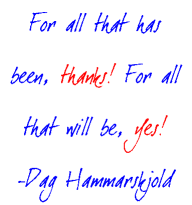
We rejoice, yet there remains much work to
do at all the levels of The Episcopal Church! We need to turn the
legislative milestones achieved at Anaheim
To support our
advocacy and education efforts during this triennium, Integrity USA
Peace,
The Rev. David Norgard
President
P.S. A contribution
of $1000 or more will qualify you for lifetime membership. Remember that
donations to Integrity are tax-deductible.
Wednesday, January 27, 2010
Presiding Bishop meets with UN Secretary General & Rowan Williams
.jpg)
[January 27, 2010] Episcopal Church Presiding Bishop Katharine Jefferts Schori met with Secretary General of the United Nations Ban Ki-moon and the Archbishop of Canterbury Rowan Williams. The following are comments from the Presiding Bishop about the meeting.
____________
The meeting on Tuesday, January 26 with the Secretary General of the United Nations Ban Ki-moon and the Archbishop of Canterbury Rowan Williams was marked by openness to partnership and a respect for the large role that faith communities play in healing the world today.
We talked about the devastation in Haiti and the resulting vulnerability of all people there, and most particularly the very disturbing stories that are emerging about human trafficking of children.
The Episcopal Church has been in Haiti for 150 years – working in schools, universities, hospitals and churches. We will be there for many years to come. I know that the whole Church shares my concern for the welfare of Haiti’s most vulnerable.
Our conversation also included a discussion of Sudan and upcoming elections there. I asked what lessons had been learned from Liberia and Rwanda. What can we do now to prevent further instability and violence? The Secretary General is working to insure that the outcome in Sudan is different this time.
We discussed progress made toward the Millennium Development Goals. Although there has been progress, it is sad to note that only one other developed nation has provided less of its committed funding than the United States. While all of the goals will not be achieved by 2015, now is the time to consider what the next phase will entail. We understand a great deal about what works and what still needs work, and it is time to develop the plan for carrying the goals forward to and beyond 2015.
I was heartened by the substantive conversation and grateful for the time spent with the Archbishop of Canterbury and the Secretary General. I am hopeful for further conversations and partnerships to come.
The Most Rev. Katharine Jefferts Schori
Presiding Bishop
The Episcopal Church
____________
The meeting on Tuesday, January 26 with the Secretary General of the United Nations Ban Ki-moon and the Archbishop of Canterbury Rowan Williams was marked by openness to partnership and a respect for the large role that faith communities play in healing the world today.
We talked about the devastation in Haiti and the resulting vulnerability of all people there, and most particularly the very disturbing stories that are emerging about human trafficking of children.
The Episcopal Church has been in Haiti for 150 years – working in schools, universities, hospitals and churches. We will be there for many years to come. I know that the whole Church shares my concern for the welfare of Haiti’s most vulnerable.
Our conversation also included a discussion of Sudan and upcoming elections there. I asked what lessons had been learned from Liberia and Rwanda. What can we do now to prevent further instability and violence? The Secretary General is working to insure that the outcome in Sudan is different this time.
We discussed progress made toward the Millennium Development Goals. Although there has been progress, it is sad to note that only one other developed nation has provided less of its committed funding than the United States. While all of the goals will not be achieved by 2015, now is the time to consider what the next phase will entail. We understand a great deal about what works and what still needs work, and it is time to develop the plan for carrying the goals forward to and beyond 2015.
I was heartened by the substantive conversation and grateful for the time spent with the Archbishop of Canterbury and the Secretary General. I am hopeful for further conversations and partnerships to come.
The Most Rev. Katharine Jefferts Schori
Presiding Bishop
The Episcopal Church
Hmmmmmmm - Not a word about Uganda! Very disappointing!!
Integrity Board News


Integrity's Board of Directors met in Pasadena, CA. from January 14th thru the 16th at All Saints Church.

Front row: David Norgard & Albert Ogle
Back row: David Cupps, Neil Houghton, Louise Brooks & Gretchen Renfro

The Board worked very long and hard and adopted a new strategic plan which is designed to take the victories from General Convention 2009 and make them a reality in each and every diocese in the church.
Other big news was from Integrity Vice President of Local Affairs, Neil Houghton (upper right) as he reported back from his trip to visit Integrity Puget Sound on his way to Pasadena. Neil has joined the blogoshere with the creation of his new blog: Many Things to Say. You can read detailed versions on his trip there but he wished to share some of his story with Walking With Integrity.

Above the Integrity Puget Sound group that gathered to meet with Neil.

Neil joined the group in a review of what is happening now, a thorough look at the group's goal goals and then they began to prioritize how mission is put into action.

The meeting was aptly facitiliated by Matt Haines, the Provincial Coordinator of Province VII.
Houghton reported that this Integrity chapter clearly has something to celebrate: their active involvement in Lambert House, a drop-in center for LGBT Youth. They fund meals twice a week. The members spoke of this with a sense of joy in what they are doing and how it involves them in the community.
Part of Neil's plan as Vice President of Local Affairs is to travel to all the provinces and meet with many Integrity chapters throughout the country. To follow more about Neil's plans and travels and musings, be sure to check out his new blog; Many Things to Say.
Integrity USA Seeks Executive Director
Integrity USA United States
In concert with the Board of Directors, the E.D. leads the
organization strategically in advancing its mission and in sustaining its
support, tangible and intangible. He or
she serves as spokesperson, development officer and administrator. The Executive Director is responsible for the
day-to-day management and execution of all aspects of the organization’s
operations, including programs, resource development, and administration.
The Executive Director of Integrity must be knowledgeable
about the Episcopal Church and its people.
He or she must be knowledgeable about the struggle for the moral
equality of LGBT people in the church and society. He or she must have demonstrated experience,
knowledge and skills in church and/or nonprofit management, development, and
governance. An individual who has earned
a bachelor’s degree is preferred.
Compensation will be commensurate with experience and qualifications.
Click
here for more information on the requirements and responsibilities of this
position. To apply or for more information, contact board president David
Norgard at davidnorgard@od180.com. Application deadline is February 21,
2010. For more information about
Integrity USA
Tuesday, January 26, 2010
RELIGIOUS LEADERS TO ANNOUNCE AMERICAN PRAYER HOUR
Multi-City
Prayer Hour Offers Alternative to the National Prayer Breakfast Whose Leaders
Have Apparent Ties to Uganda’s Draconian Anti-Homosexuality
Bill
When:
Tuesday, February 2, 2010 – 10:30 a.m.
(EST)
Where:
The National Press Club
(Washington, DC) Murrow Room
529
14th St. NW, 13th Floor - Washington, DC 20045
Who: Bishop Gene Robinson, the first openly
gay bishop in the Episcopal Church
Frank
Schaeffer,
author, “Crazy For God: How I Grew Up As One of the Elect, Helped Found the
Religious Right and Lived to Take All Back.”
Harry Knox, The Human Rights Campaign,
Director of Religion and Faith
Moses,
A gay Ugandan man seeking asylum in The United States
Rev.
Elder Darlene Garner,
Metropolitan Community Church, Board of Elder
Bishop
Carlton Pearson,
Senior Interim Minister at Chicago, Illinois’s
Christ
Universal Temple
Background:
Uganda is considering the Anti-Homosexuality Bill 2009, put forth by
parliamentarian David Bahati and initially backed by
President Yoweri Museveni.
If passed, the new law would unleash a vicious campaign of persecution against
LGBT citizens. Bahati and President Museveni are members of The Family and are among their “key
men” in Africa. The Family hosts the annual National Prayer Breakfast in
Washington. The American Prayer Hour will show that such cruelty and extremism does not represent most people of
faith.
God's Call and Our Response: New Publication from the Chicago Consultation

January 25, 2010
|
|
Dear Chicago Consultation friends:
Earlier this month, diocesan standing committees and bishops with jurisdiction were formally notified of the election of the Rev. Mary Glasspool as bishop suffragan in the Diocese of Los Angeles. Bishop-elect Glasspool is the second openly gay, partnered person to be elected bishop in the Anglican Communion. The 2009 General Convention of the Episcopal Church affirmed, through Resolution D025, that God calls partnered gay and lesbian people to all orders of ministry in the Episcopal Church. The Chicago Consultation believes that this position is consistent with traditional Anglican polity and theology. To aid standing committees and bishops with their role in the consent process, we have published a collection of essays by eminent theologians across the Episcopal Church. Our new publication, God's Call and Our Response, is edited by the Rev. Dr. Ruth A. Meyers, Hodges-Haynes Professor of Liturgics at · The Rev. Canon Gary R. Hall, Ph.D, Hills, · The Rev. Jay Emerson Johnson, Ph.D., Graduate Theological Union, · The Rev. Dr. John Kater, Professor Emeritus of Ministry Development, · Dr. Fredrica Harris Thompsett, Mary Wolfe Professor of Historical Theology, Episcopal We invite you to download God's Call and Our Response and share the link with anyone you know who might find it useful. Please also visit the Chicago Consultation's website and join us on Facebook to learn more about our work. If you have questions, please email us at info@chicagoconsultation.org. Thank you, as always, for your prayers and support. Faithfully, The Co-Conveners: The Rev. Jennifer Adams, Grace Episcopal Church, The Very Rev. Dr. Brian Baker, Trinity Episcopal Cathedral, The Rev. Lowell Grisham, The Rev. Bonnie A. Perry, All Saints' Episcopal Church, |
Monday, January 25, 2010
God’s not dead: How LA fills the pews ... and we don’t
From Ruth Gledhill's column in The Times......
Lucy Broadbent
It’s not that I am especially pious. Believe me, I was mostly praying for cashmere this Christmas. As the old joke goes: Am I religious? No, I’m Church of England. But I have a confession to make: I do go to church, and not just at Christmas either. I go all the time. Even on weekdays sometimes.
I’m aware that such an admission is rather like owning up to being a trainspotter these days, but then I don’t have to put up with the desolate aisles and empty pews that most of you have become familiar with in Britain — where the best that can be hoped for on a Sunday is a faint whiff of incense and three old ladies and a homeless person singing watery hymns.
According to a report published tomorrow there is a sharp decline in religious belief in Britain. Half the population now calls itself Christian, down from two thirds in 1983. At the same time, the proportion who confess to “no religion” has increased from just under a third to more than four in ten. If Jews and Muslims are included, non-Christians now represent 7 per cent of the population, up from 2 per cent 25 years ago.
I hate to sound as if I’m boasting, but at the Anglican church my family attends in Los Angeles, you have to go early if you want a seat. Rather like being at a football match when your team has just won, the sheer numbers alone leave you with a spring in your step and a song on your lips.
St James Church, which sits at the intersection of an affluent middle-class neighbourhood, and many poorer communities in LA, is an Episcopal Church, that is the American equivalent of the Church of England. But, unlike its British cousins, it is packed because it goes out of its way to create a community in a big, sprawling city. There’s a supper club on Wednesday nights, set up with the intention of giving mums a night off, and a chance for families to make friends.
There is also an elementary school, a nursery school and a reasonably priced child-care centre for working families. Then there’s the aerobics classes in the church hall — always popular; boy scout meetings — my son won’t miss one; and a soup kitchen for the homeless. Sometimes, if you are trying to raise a family, it’s hard to stay away from the place.
When I moved to LA a dozen or so years ago, religion was incidental to my life. Unless on a turbulent aircraft, indifference beckoned. There were a few childhood memories of Sunday school and sitting in a pew with a children’s Bible. But religion had slipped into cobwebbed disuse as soon as the teen years took over. Spirituality? Well, I listened to reggae music at parties. If I’d stayed in Britain, I’d probably have become another of the lost Christians.
But the combination of having children and moving to the US changed everything. It led to finding a school for my boys that happened to be attached to an Episcopal church, which meant there were all-school chapel services, and care for the spiritual well being of a child, not just academic achievement — something with which we were familiar from our own childhoods. Subconsciously, my husband and I were probably seduced by the similarities the school had with memories of England.
We started attending the church. Our eldest joined the choir. The hymns were the same, even if they got the tunes wrong, and the words of the service were as I remembered them growing up in a village in Hertfordshire 40-odd years before.
While churches in England have, for the most part, modernised their services in an attempt to attract bigger crowds — some of them becoming painfully evangelical and happy clappy — the Episcopal church in the US still uses the older, traditional liturgies, the ones that I remember nostalgically. It was these superficial trappings that appealed to us originally. My husband, who writes music for a living, is a sucker for a choir — but it is the values that we found there that has really kept us coming back.
At our church, it is not unusual to see children with two mums or two dads, sitting next to Koreans, African-Americans, Hispanics, as well as many white middle-class families. There are monied people from Beverly Hills, rubbing shoulders with artists from downtown. Gay people next to straight. It’s jolly, social and somehow has a relevance to everyone’s life. It reflects an acceptance of all, the kind of value I’d like my children to have. And it is a community. Spirituality, I believe, comes from acknowledging that we are part of something greater than just ourselves.
My father, who lives in London and used to take me to church as a child, no longer attends church. He compares sitting in an empty church with being a sole diner in a restaurant — miserable. What’s on offer in church has no connection to his life any more. Instead he goes to a business networking group to find community and carries his own ideas of spirituality inside his head. My mother (now separated from my father) still attends church, but she is one of only seven who attend regularly in her village. There are so few in the congregation, they all sit in the choir stalls.
I am now largely embarrassed by the Archbishop of Canterbury, Rowan Williams, who took it upon himself to advise the bishops of the diocese of LA against electing the Rev Canon Mary D. Glasspool to be a bishop, because she happens to be openly gay.
I asked our rector, the Rev Paul Kowalewski, why his church was always full. “We are part of a community,” he says. “In a big city like Los Angeles, people are looking for a community. We give them the welcome they are looking for.”
Hope in SW London
Tomorrow’s report will make grim reading on the decline of faith in Britain. The analysis by Professor David Voas, for the National Centre for Social Research of the 4,486 interviews in the 2008 British Social Attitudes survey, points to the steepest fall being among those who attend worship ceremonies in the Church of England.
Average Sunday attendance in 2007 fell to 978,000 compared with 1.2 million in 1983.
Voas says: “The declining Christian share is largely attributable to a drift away from the Church of England.” In church circles the accepted wisdom is that the decline can be linked to a move in liberal congregations away from biblical orthodoxy.
Figures from organisations such as Christian Research support the widely accepted thesis that all the growth is at the evangelical end.
But closer examination of thriving churches, such as the Los Angeles church profiled here by Lucy Broadbent, show that this need not be the case.
Canon Giles Fraser, Chancellor of St Paul’s, was until recently vicar of St Mary’s, Putney, in which there is hardly enough space in the church to hold the 350 Sunday worshippers, including 100 children.
What marks this church and many others in southwest London is that they are far from evangelical, unless that is taken in its original Greek and, ironically, biblical sense of being messengers of good news.
Canon Fraser’s “gospel” for success was a book by Dr Jeffrey John on how to do church well. Dr John is now Dean of St Albans having been forced to resign as Bishop of Reading because of his sexuality.
The Anglican Communion’s first openly gay bishop, Gene Robinson, preached at St Mary’s at the start of the 2008 Lambeth Conference in Canterbury. The Inclusive Church movement that campaigns for equality for gays in the church was started there by Canon Fraser. And the motion that eventually saw the General Synod agree in 1992 that women could be ordained to the priesthood began life with a motion from the parochial church council at St Mary’s.
St Mary’s has a café on the premises and a heavily oversubscribed church school near by. Just a dozen or so children from the congregation are admitted there each year — so the school does not explain the overflowing pews, or why so many families stay even when their children don’t make it through the admissions process.
What St Mary’s and its other local thriving churches do prove is that it is possible to be inclusive as a church in England, and not only survive but thrive. Canon Fraser says: “It is just a question of doing the basics and doing them well. It is caring for people, preaching good sermons, making sure to be organised. There is a huge children’s programme with Sunday school teachers trained in what is called Godly Play. A lot of churches in that area are not evangelical but they are full.”
Holy Trinity Brompton, in Knightsbridge, southwest London, is packed with thousands of young Christians each Sunday and is the church where the successful Alpha course began. It is another example of a growing church.
From the opposite end of the evangelical spectrum to St Mary’s Putney, HTB has a more conventional approach to church growth, which includes “planting” or founding dozens of new congregations in London, many of which also flourish and to go on to plant yet more churches.
Since the 1960s it has been part of the secular creed that “God is dead”. But in spite of surveys such as tomorrow’s, the evidence is that belief in God is anything but dead. Churches and other religions across the spectrum have continued to defy prophecies of their imminent demise and, against the statistics, the signs are that they will continue to do so.
Ruth Gledhill, Religion Correspondent
Lucy Broadbent

It’s not that I am especially pious. Believe me, I was mostly praying for cashmere this Christmas. As the old joke goes: Am I religious? No, I’m Church of England. But I have a confession to make: I do go to church, and not just at Christmas either. I go all the time. Even on weekdays sometimes.
I’m aware that such an admission is rather like owning up to being a trainspotter these days, but then I don’t have to put up with the desolate aisles and empty pews that most of you have become familiar with in Britain — where the best that can be hoped for on a Sunday is a faint whiff of incense and three old ladies and a homeless person singing watery hymns.
According to a report published tomorrow there is a sharp decline in religious belief in Britain. Half the population now calls itself Christian, down from two thirds in 1983. At the same time, the proportion who confess to “no religion” has increased from just under a third to more than four in ten. If Jews and Muslims are included, non-Christians now represent 7 per cent of the population, up from 2 per cent 25 years ago.
I hate to sound as if I’m boasting, but at the Anglican church my family attends in Los Angeles, you have to go early if you want a seat. Rather like being at a football match when your team has just won, the sheer numbers alone leave you with a spring in your step and a song on your lips.
St James Church, which sits at the intersection of an affluent middle-class neighbourhood, and many poorer communities in LA, is an Episcopal Church, that is the American equivalent of the Church of England. But, unlike its British cousins, it is packed because it goes out of its way to create a community in a big, sprawling city. There’s a supper club on Wednesday nights, set up with the intention of giving mums a night off, and a chance for families to make friends.
There is also an elementary school, a nursery school and a reasonably priced child-care centre for working families. Then there’s the aerobics classes in the church hall — always popular; boy scout meetings — my son won’t miss one; and a soup kitchen for the homeless. Sometimes, if you are trying to raise a family, it’s hard to stay away from the place.
When I moved to LA a dozen or so years ago, religion was incidental to my life. Unless on a turbulent aircraft, indifference beckoned. There were a few childhood memories of Sunday school and sitting in a pew with a children’s Bible. But religion had slipped into cobwebbed disuse as soon as the teen years took over. Spirituality? Well, I listened to reggae music at parties. If I’d stayed in Britain, I’d probably have become another of the lost Christians.
But the combination of having children and moving to the US changed everything. It led to finding a school for my boys that happened to be attached to an Episcopal church, which meant there were all-school chapel services, and care for the spiritual well being of a child, not just academic achievement — something with which we were familiar from our own childhoods. Subconsciously, my husband and I were probably seduced by the similarities the school had with memories of England.
We started attending the church. Our eldest joined the choir. The hymns were the same, even if they got the tunes wrong, and the words of the service were as I remembered them growing up in a village in Hertfordshire 40-odd years before.
While churches in England have, for the most part, modernised their services in an attempt to attract bigger crowds — some of them becoming painfully evangelical and happy clappy — the Episcopal church in the US still uses the older, traditional liturgies, the ones that I remember nostalgically. It was these superficial trappings that appealed to us originally. My husband, who writes music for a living, is a sucker for a choir — but it is the values that we found there that has really kept us coming back.
At our church, it is not unusual to see children with two mums or two dads, sitting next to Koreans, African-Americans, Hispanics, as well as many white middle-class families. There are monied people from Beverly Hills, rubbing shoulders with artists from downtown. Gay people next to straight. It’s jolly, social and somehow has a relevance to everyone’s life. It reflects an acceptance of all, the kind of value I’d like my children to have. And it is a community. Spirituality, I believe, comes from acknowledging that we are part of something greater than just ourselves.
My father, who lives in London and used to take me to church as a child, no longer attends church. He compares sitting in an empty church with being a sole diner in a restaurant — miserable. What’s on offer in church has no connection to his life any more. Instead he goes to a business networking group to find community and carries his own ideas of spirituality inside his head. My mother (now separated from my father) still attends church, but she is one of only seven who attend regularly in her village. There are so few in the congregation, they all sit in the choir stalls.
I am now largely embarrassed by the Archbishop of Canterbury, Rowan Williams, who took it upon himself to advise the bishops of the diocese of LA against electing the Rev Canon Mary D. Glasspool to be a bishop, because she happens to be openly gay.
I asked our rector, the Rev Paul Kowalewski, why his church was always full. “We are part of a community,” he says. “In a big city like Los Angeles, people are looking for a community. We give them the welcome they are looking for.”
Hope in SW London
Tomorrow’s report will make grim reading on the decline of faith in Britain. The analysis by Professor David Voas, for the National Centre for Social Research of the 4,486 interviews in the 2008 British Social Attitudes survey, points to the steepest fall being among those who attend worship ceremonies in the Church of England.
Average Sunday attendance in 2007 fell to 978,000 compared with 1.2 million in 1983.
Voas says: “The declining Christian share is largely attributable to a drift away from the Church of England.” In church circles the accepted wisdom is that the decline can be linked to a move in liberal congregations away from biblical orthodoxy.
Figures from organisations such as Christian Research support the widely accepted thesis that all the growth is at the evangelical end.
But closer examination of thriving churches, such as the Los Angeles church profiled here by Lucy Broadbent, show that this need not be the case.
Canon Giles Fraser, Chancellor of St Paul’s, was until recently vicar of St Mary’s, Putney, in which there is hardly enough space in the church to hold the 350 Sunday worshippers, including 100 children.
What marks this church and many others in southwest London is that they are far from evangelical, unless that is taken in its original Greek and, ironically, biblical sense of being messengers of good news.
Canon Fraser’s “gospel” for success was a book by Dr Jeffrey John on how to do church well. Dr John is now Dean of St Albans having been forced to resign as Bishop of Reading because of his sexuality.
The Anglican Communion’s first openly gay bishop, Gene Robinson, preached at St Mary’s at the start of the 2008 Lambeth Conference in Canterbury. The Inclusive Church movement that campaigns for equality for gays in the church was started there by Canon Fraser. And the motion that eventually saw the General Synod agree in 1992 that women could be ordained to the priesthood began life with a motion from the parochial church council at St Mary’s.
St Mary’s has a café on the premises and a heavily oversubscribed church school near by. Just a dozen or so children from the congregation are admitted there each year — so the school does not explain the overflowing pews, or why so many families stay even when their children don’t make it through the admissions process.
What St Mary’s and its other local thriving churches do prove is that it is possible to be inclusive as a church in England, and not only survive but thrive. Canon Fraser says: “It is just a question of doing the basics and doing them well. It is caring for people, preaching good sermons, making sure to be organised. There is a huge children’s programme with Sunday school teachers trained in what is called Godly Play. A lot of churches in that area are not evangelical but they are full.”
Holy Trinity Brompton, in Knightsbridge, southwest London, is packed with thousands of young Christians each Sunday and is the church where the successful Alpha course began. It is another example of a growing church.
From the opposite end of the evangelical spectrum to St Mary’s Putney, HTB has a more conventional approach to church growth, which includes “planting” or founding dozens of new congregations in London, many of which also flourish and to go on to plant yet more churches.
Since the 1960s it has been part of the secular creed that “God is dead”. But in spite of surveys such as tomorrow’s, the evidence is that belief in God is anything but dead. Churches and other religions across the spectrum have continued to defy prophecies of their imminent demise and, against the statistics, the signs are that they will continue to do so.
Ruth Gledhill, Religion Correspondent
Sunday, January 24, 2010
"Fear Not" -- A Report from the Massachusetts Front
From The Rev. Dr. Cameron Partridge

For I am convinced that neither death, nor life, nor angels, nor rulers, nor things present, nor things to come, nor powers, nor height, nor depth, nor anything else in all creation, will be able to separate us from the love of God in Christ Jesus our Lord. - Romans 8:38-39
 A lobby day for transgender equality yesterday capped off what has been, to put it mildly, an extraordinarily intense week here in Massachusetts.
I attended the lobby day in support the H1728/S1687 “An Act Relative To Gender-Based Discrimination and Hate Crimes” bill with my partner and our three-month-old son, and delivered a brief invocation at the end of the speeches in my capacity as Co-Chair of the locally based InterfaithCoalition for Transgender Equality.
The mood in the historic Nurses Hall at the State House was tense, energetic, and laced with anger in the wake of Republican Scott Brown’s Tuesday defeat of Democratic U.S. Senate candidate Martha Coakley. Brown’s win removes Senate Democrats’ sixty-vote supermajority and imperils the passage of national health care reform legislation.
Coakley had been widely backed by the state’s transgender community, as Massachusetts Transgender Political Coalition Executive Director Gunner Scott forcefully expressed in a Bay Windows opinion letter last September: “as State Attorney General, Martha Coakley came out early for transgender civil rights as the first statewide elected official to publicly support ‘An Act Relative to Gender-Based Discrimination and Hate Crimes.’” Coakley also “sought civil rights injunctions in numerous cases involving hate crimes against LGBT victims” including one “against two men who attacked a transgender teenager in a Dorchester pizza shop.”
Meanwhile, as Chuck Colbert reported in Bay Windows yesterday, the Massachusetts LGBT community was angered this election by “anti gay-baiting robo calls” that began plaguing Massachusetts phone lines three days before voters hit the polls. Originating “in a 202 area code from the Washington, D.C. [area], a recorded male voice asks residents if they view marriage defined as ‘only between one man and one woman.’ If they indicated ‘Yes’ they were urged to vote for Brown, ‘the only candidate with a proven track record’ of supporting traditional marriage. The call also labeled Coakley as a ‘radical’ same-sex marriage supporter who opposed letting the people vote on the issue and who used taxpayer dollars to support a same-sex marriage ‘agenda.’”
With the Supreme Court just yesterday approving by a 5-4 margin that corporations and labor unions can spend unlimited amounts on federal elections, the floodgates of such robo-calls and other methods of bombardment would appear to be opening at the national level.
The majority opinion, penned by Justice Anthony Kennedy, argued that to prevent such spending is to censure free speech. “When government seeks to use its full power, including the criminal law, to command where a person may get his or her information or what distrusted source he or she may not hear, it uses censorship to control thought,’’ he wrote.
Add to this mix the continuing cloud of grief and anxiety hovering over the many intersecting communities devastated by last week’s 7.0 earthquake in Haiti. Numerous people in New England had connections to the events in Haiti, including members of the large Boston Area Haitian community, the Sisters of Saint Margaret, and medical teams from Boston based Partners in Health.
 And add to that list the trans community which learned last weekend of the death of Flo McGarell, a visual artist and transman from Newbury, Vermont, who lived in the city of Jacmal for the past six years, serving as director of the FOSAJ, a non-profit art center. The New England Cable News did what struck me as a very respectful interview with McGarrell’s grieving parents and, perhaps without meaning to, gestured toward the complexity of McGarrell’s gender identity and expression.
In an in-depth interview with the art 21 blog about his wildly creative art, Flo described himself as “a total gender mash up” which was “a constant and humorous topic of discussion” in Jacmal. When asked about what guided his artistic vision, Flo answered:
With such losses along with the sour economy on the minds of lobby day attendees yesterday, a fundamental question emerged: how can we help return a sense of confidence to lawmakers who may be afraid to fight for any legislation considered “controversial” right now? How can we break through this late-January crust of fear?
Fear may be eroding Massachusetts’s transgender nondiscrimination legislation, just as it is at work in the stalled Employment Nondiscrimination Act in Washington. D.C. How is it that over 105 state lawmakers (out of a total of 200) have signed on as co-sponsors of the MA bill, that a poll conducted last November by Lake Research Partners showed that 76% of Massachusetts residents and 80% of Massachusetts women support it, that Governor Deval Patrick has signaled his enthusiastic support, and still this bill has not gotten out of committee? We cannot let the events of this week, devastating as they are, deter us from this crucial task.
As I think and pray about all of these swirling currents, as I watch the dynamics of fear playing out all around me, I can’t help but think of McGarrell’s conscious ethic of fearlessness. And that sentiment, in this week’s context, draws my mind to the Apostle Paul writing to communities in Rome about the eager longing with which creation waits to be set free from its bondage. We may groan inwardly now, he says, and we may feel alone in our labor, but the Spirit indeed intercedes for us, and urges us onward, never, ever separate from the love of God, as we collaborate in building God’s glorious dream.
As the three of us emerged from the State House, we were dazzled by a brilliant, cold blue sky and streams of sunlight.
************************************
Here is the invocation, which uses language tailored for a group of numerous religious (and nonreligious) traditions:
Nurses’s Hall, State House ~ Boston, Massachusetts
January 21, 2010
An Invocation for Transgender Lobby Day
May the Holy One of all our traditions bless, protect and empower us, illumining us with insight, calm and unfathomable fortitude.
May we be reminded of the remarkable strength that lies within us, urging us onward even in face of the steepest odds.
May our hearts be filled with gratitude and awe for the sacred community gathered here today: trans people, partners, allies, families of all configurations, people of all races and ethnicities, sexual orientations, national origins, religious and spiritual traditions, professions and vocations.
May the Divine Spirit flowing among us stir up our prophetic anger at the evils of apathy and expediency as much as of bigotry and ignorance.
And may we go forth with boldness, empowered to bear witness to the truth of our lives and the birthright of our human dignity.
All this we ask in the name of the All-Holy One who urges us into life and love, and sets us free. Amen.
The Rev. Dr. Cameron Partridge is Vicar of St. Luke’s and St. Margaret’s Episcopal Church in Allston, MA and an academic whose scholarly interests center on the history of Christianity and theological constructions of sex/gender/sexuality. A transgender man, Cameron is a member of TransEpiscopal, Integrity USA, and co-chair of the Interfaith Coalition for Transgender Equality.

For I am convinced that neither death, nor life, nor angels, nor rulers, nor things present, nor things to come, nor powers, nor height, nor depth, nor anything else in all creation, will be able to separate us from the love of God in Christ Jesus our Lord. - Romans 8:38-39
 A lobby day for transgender equality yesterday capped off what has been, to put it mildly, an extraordinarily intense week here in Massachusetts.
 I attended the lobby day in support the H1728/S1687 “An Act Relative To Gender-Based Discrimination and Hate Crimes” bill with my partner and our three-month-old son, and delivered a brief invocation at the end of the speeches in my capacity as Co-Chair of the locally based InterfaithCoalition for Transgender Equality.
The mood in the historic Nurses Hall at the State House was tense, energetic, and laced with anger in the wake of Republican Scott Brown’s Tuesday defeat of Democratic U.S. Senate candidate Martha Coakley. Brown’s win removes Senate Democrats’ sixty-vote supermajority and imperils the passage of national health care reform legislation.
Coakley had been widely backed by the state’s transgender community, as Massachusetts Transgender Political Coalition Executive Director Gunner Scott forcefully expressed in a Bay Windows opinion letter last September: “as State Attorney General, Martha Coakley came out early for transgender civil rights as the first statewide elected official to publicly support ‘An Act Relative to Gender-Based Discrimination and Hate Crimes.’” Coakley also “sought civil rights injunctions in numerous cases involving hate crimes against LGBT victims” including one “against two men who attacked a transgender teenager in a Dorchester pizza shop.”
Meanwhile, as Chuck Colbert reported in Bay Windows yesterday, the Massachusetts LGBT community was angered this election by “anti gay-baiting robo calls” that began plaguing Massachusetts phone lines three days before voters hit the polls. Originating “in a 202 area code from the Washington, D.C. [area], a recorded male voice asks residents if they view marriage defined as ‘only between one man and one woman.’ If they indicated ‘Yes’ they were urged to vote for Brown, ‘the only candidate with a proven track record’ of supporting traditional marriage. The call also labeled Coakley as a ‘radical’ same-sex marriage supporter who opposed letting the people vote on the issue and who used taxpayer dollars to support a same-sex marriage ‘agenda.’”
With the Supreme Court just yesterday approving by a 5-4 margin that corporations and labor unions can spend unlimited amounts on federal elections, the floodgates of such robo-calls and other methods of bombardment would appear to be opening at the national level.
The majority opinion, penned by Justice Anthony Kennedy, argued that to prevent such spending is to censure free speech. “When government seeks to use its full power, including the criminal law, to command where a person may get his or her information or what distrusted source he or she may not hear, it uses censorship to control thought,’’ he wrote.
Add to this mix the continuing cloud of grief and anxiety hovering over the many intersecting communities devastated by last week’s 7.0 earthquake in Haiti. Numerous people in New England had connections to the events in Haiti, including members of the large Boston Area Haitian community, the Sisters of Saint Margaret, and medical teams from Boston based Partners in Health.
 And add to that list the trans community which learned last weekend of the death of Flo McGarell, a visual artist and transman from Newbury, Vermont, who lived in the city of Jacmal for the past six years, serving as director of the FOSAJ, a non-profit art center. The New England Cable News did what struck me as a very respectful interview with McGarrell’s grieving parents and, perhaps without meaning to, gestured toward the complexity of McGarrell’s gender identity and expression.
In an in-depth interview with the art 21 blog about his wildly creative art, Flo described himself as “a total gender mash up” which was “a constant and humorous topic of discussion” in Jacmal. When asked about what guided his artistic vision, Flo answered:
“Don’t hide, don’t lie.His loved ones are organizing memorials and tributes at this site.
Do that which scares me.
Resist the urge to settle.
Be as many things as possible in this lifetime.”
With such losses along with the sour economy on the minds of lobby day attendees yesterday, a fundamental question emerged: how can we help return a sense of confidence to lawmakers who may be afraid to fight for any legislation considered “controversial” right now? How can we break through this late-January crust of fear?
Fear may be eroding Massachusetts’s transgender nondiscrimination legislation, just as it is at work in the stalled Employment Nondiscrimination Act in Washington. D.C. How is it that over 105 state lawmakers (out of a total of 200) have signed on as co-sponsors of the MA bill, that a poll conducted last November by Lake Research Partners showed that 76% of Massachusetts residents and 80% of Massachusetts women support it, that Governor Deval Patrick has signaled his enthusiastic support, and still this bill has not gotten out of committee? We cannot let the events of this week, devastating as they are, deter us from this crucial task.
As I think and pray about all of these swirling currents, as I watch the dynamics of fear playing out all around me, I can’t help but think of McGarrell’s conscious ethic of fearlessness. And that sentiment, in this week’s context, draws my mind to the Apostle Paul writing to communities in Rome about the eager longing with which creation waits to be set free from its bondage. We may groan inwardly now, he says, and we may feel alone in our labor, but the Spirit indeed intercedes for us, and urges us onward, never, ever separate from the love of God, as we collaborate in building God’s glorious dream.
As the three of us emerged from the State House, we were dazzled by a brilliant, cold blue sky and streams of sunlight.
************************************
Here is the invocation, which uses language tailored for a group of numerous religious (and nonreligious) traditions:
Nurses’s Hall, State House ~ Boston, Massachusetts
January 21, 2010
An Invocation for Transgender Lobby Day
May the Holy One of all our traditions bless, protect and empower us, illumining us with insight, calm and unfathomable fortitude.
May we be reminded of the remarkable strength that lies within us, urging us onward even in face of the steepest odds.
May our hearts be filled with gratitude and awe for the sacred community gathered here today: trans people, partners, allies, families of all configurations, people of all races and ethnicities, sexual orientations, national origins, religious and spiritual traditions, professions and vocations.
May the Divine Spirit flowing among us stir up our prophetic anger at the evils of apathy and expediency as much as of bigotry and ignorance.
And may we go forth with boldness, empowered to bear witness to the truth of our lives and the birthright of our human dignity.
All this we ask in the name of the All-Holy One who urges us into life and love, and sets us free. Amen.
The Rev. Dr. Cameron Partridge is Vicar of St. Luke’s and St. Margaret’s Episcopal Church in Allston, MA and an academic whose scholarly interests center on the history of Christianity and theological constructions of sex/gender/sexuality. A transgender man, Cameron is a member of TransEpiscopal, Integrity USA, and co-chair of the Interfaith Coalition for Transgender Equality.
Thursday, January 21, 2010
"..an inescapable network of mutuality."
A Sermon by the Most Rev. Katharine Jefferts Schori
St. Andrew and Holy Communion, South Orange, NJ
The Rev. Dr. Martin Luther King, Jr.
January 17, 2010
A few minutes ago we gave thanks for the many saints who have come before us, for our ancestors and our brothers and sisters in the Body of Christ, for all who have toiled to build the world we have dreamed of, the dream the prophets continue to hold before us, of that world we have not yet seen in its fullness.
Moses led his people out of Egypt in search of that dream, of a land of milk and honey, where slavery would be left behind, and no one’s labor would be stolen by the powerful, where God’s children might live in peace and abundance. It’s the same dream that the prophet Martin Luther King held before us – a world where no one goes hungry, where each one has a decent shelter at night, where all have an equal claim on justice. It is the eternal dream of God’s spirit within us, and the vision that Jesus urges on his followers. This dream is not just a dream for the end time. This dream comes among us like a thief in the night, it sneaks up on us when we’re not paying attention, and this dream lives within us.
We’ve confronted that dream this week as we’ve seen the terror of Haiti, a land shaken by the impersonal forces of an ever-changing globe. It’s also a terror in which human forces play an enormous role. The dream of God is evident in the care of one Haitian for another, and in the care of the world’s urgent response.
We know that most of the buildings of the Episcopal Diocese of Haiti in and around Port-au-Prince have been destroyed. Two of our young adult missionaries who’ve been teaching theology there are on their way home. I have not been able to reach the bishop yet, but one of those young adults reports that Bishop Zaché Duracin has organized a camp of several thousand persons, caring for those with nowhere else to go. This includes the bishop, whose own home has been destroyed. They have water and some food, and a purpose – to care for each other and for the suffering around them. The dream of God is becoming real on that soccer field, in small and hidden ways.
At the same time our hearts are breaking as we see the bodies and hear the stories about not knowing where family members are. Those with experience in disasters, whether you lived through the aftermath of 9/11 or Katrina, or the professionals, who do this compassionate work for a living, know that the recovery and rebuilding will take a very long time. The damage in Haiti is far worse than it was when an equivalent earthquake hit San Francisco 20 years ago, when only 62 people died – it’s worse because the infrastructure in Haiti is so poor, and the buildings there so fragile. It is a result of poverty.
And that poverty is what the prophet Martin would challenge us about. Haiti has its roots in a history of slavery. Spaniards first imported Africans as slaves to the island on which Haiti sits in 1517. The island went back and forth between Spanish and French control over the next two centuries, with the French eventually colonizing the western part. In 1804, a slave revolt led to the first independent nation in Latin America, the second independent nation in this hemisphere after the United States, the first post-colonial black-led nation anywhere, and the first nation established as the result of a successful slave rebellion. If that isn’t an Exodus story, I don’t know what is. The Haitians were delivered from Pharaoh, led by their own team of Moseses. Yet they have never tasted much milk and honey.
Martin the prophet would remind us that there are still slaves around us – those who live in thralldom to grinding poverty, like the 80% of Haitians who live on less than $2 a day. That’s the kind of poverty that the first of the Millennium Development Goals is meant to relieve. Martin the prophet would remind us that there is no justice when some live in that kind of poverty. And Martin the prophet would remind us that the people of Haiti are our brothers and sisters. Did you hear his words?
How can one avoid being depressed when he sees with his own eyes evidences of millions of people going to bed hungry at night? How can one avoid being depressed when he sees with his own eyes God’s children sleeping on the sidewalks at night? Injustice anywhere is a threat to justice everywhere. We are tied together in a single garment of destiny, caught in an inescapable network of mutuality.
Martin Luther King’s ministry was focused on liberating the people of these United States, but his message pointed toward the universal liberation of all people, all God’s children, here and around the globe. The work he began here helped to liberate the people of South Africa. The ways in which Americans and faithful people around the world began to hear that universal message have made us conscious that oppression, and discrimination, and injustice anywhere are indeed our problem. We are most certainly “caught in an inescapable network of mutuality.”
This congregation is abundantly aware of that reality – it shows in your care for, and your ministry with, so many who suffer in want of food, and clothing, and shelter, and education. Your particular focus on children reminds us all that Jesus came among us as one of them, and maybe we can remember that we’re all God’s children, and that Jesus is still present among us in the most vulnerable.
What do you do when you encounter someone who is particularly vulnerable? You’ve probably heard and seen the stories about trying to get still-living people out of ruined buildings in Haiti. One man was sedated before they dragged him through a very tight spot. Others have had water piped to them through tiny hoses. Some of them had to have limbs amputated in order to deliver them from potential tombs. Rescuers do what is most needed to sustain life.
I’m struck by the image of a tiny child, newly born, newly delivered, perhaps the most vulnerable life most of us ever meet. What do we do with a child like that? Wrap it up and keep the child warm. Martin invited us as church to become a thermostat, rather than a thermometer, to be an instrument that changes the temperature of the society around us. Well, my friends, it’s time to turn the heat up. Babies are dying out there. God’s children, our brothers and sisters, are dying of neglect – our neglect to work for justice both here and around the globe. Haiti is also a child of God, teetering on the cusp of life. She needs water, food, solidarity in prayer, work for justice, redevelopment, she needs milk and honey.
Haiti is a bellwether for all the world’s children, for all God’s children, caught in that network of mutuality. None of us will arrive in that land of milk and honey of which we have dreamed for eons, none of us will enter that land until and unless we cross the river together. Only hand in hand with our neighbors, poor, hungry, thirsty, only when we keep on building that network of mutuality. Take my hand, precious Lord, and put it in the hand of my sister and my brother. Take my hand, take all our hands, and together – together - we shall come into the promised land.
January 17, 2010
A few minutes ago we gave thanks for the many saints who have come before us, for our ancestors and our brothers and sisters in the Body of Christ, for all who have toiled to build the world we have dreamed of, the dream the prophets continue to hold before us, of that world we have not yet seen in its fullness.
Moses led his people out of Egypt in search of that dream, of a land of milk and honey, where slavery would be left behind, and no one’s labor would be stolen by the powerful, where God’s children might live in peace and abundance. It’s the same dream that the prophet Martin Luther King held before us – a world where no one goes hungry, where each one has a decent shelter at night, where all have an equal claim on justice. It is the eternal dream of God’s spirit within us, and the vision that Jesus urges on his followers. This dream is not just a dream for the end time. This dream comes among us like a thief in the night, it sneaks up on us when we’re not paying attention, and this dream lives within us.
We’ve confronted that dream this week as we’ve seen the terror of Haiti, a land shaken by the impersonal forces of an ever-changing globe. It’s also a terror in which human forces play an enormous role. The dream of God is evident in the care of one Haitian for another, and in the care of the world’s urgent response.
We know that most of the buildings of the Episcopal Diocese of Haiti in and around Port-au-Prince have been destroyed. Two of our young adult missionaries who’ve been teaching theology there are on their way home. I have not been able to reach the bishop yet, but one of those young adults reports that Bishop Zaché Duracin has organized a camp of several thousand persons, caring for those with nowhere else to go. This includes the bishop, whose own home has been destroyed. They have water and some food, and a purpose – to care for each other and for the suffering around them. The dream of God is becoming real on that soccer field, in small and hidden ways.
At the same time our hearts are breaking as we see the bodies and hear the stories about not knowing where family members are. Those with experience in disasters, whether you lived through the aftermath of 9/11 or Katrina, or the professionals, who do this compassionate work for a living, know that the recovery and rebuilding will take a very long time. The damage in Haiti is far worse than it was when an equivalent earthquake hit San Francisco 20 years ago, when only 62 people died – it’s worse because the infrastructure in Haiti is so poor, and the buildings there so fragile. It is a result of poverty.
And that poverty is what the prophet Martin would challenge us about. Haiti has its roots in a history of slavery. Spaniards first imported Africans as slaves to the island on which Haiti sits in 1517. The island went back and forth between Spanish and French control over the next two centuries, with the French eventually colonizing the western part. In 1804, a slave revolt led to the first independent nation in Latin America, the second independent nation in this hemisphere after the United States, the first post-colonial black-led nation anywhere, and the first nation established as the result of a successful slave rebellion. If that isn’t an Exodus story, I don’t know what is. The Haitians were delivered from Pharaoh, led by their own team of Moseses. Yet they have never tasted much milk and honey.
Martin the prophet would remind us that there are still slaves around us – those who live in thralldom to grinding poverty, like the 80% of Haitians who live on less than $2 a day. That’s the kind of poverty that the first of the Millennium Development Goals is meant to relieve. Martin the prophet would remind us that there is no justice when some live in that kind of poverty. And Martin the prophet would remind us that the people of Haiti are our brothers and sisters. Did you hear his words?
How can one avoid being depressed when he sees with his own eyes evidences of millions of people going to bed hungry at night? How can one avoid being depressed when he sees with his own eyes God’s children sleeping on the sidewalks at night? Injustice anywhere is a threat to justice everywhere. We are tied together in a single garment of destiny, caught in an inescapable network of mutuality.
Martin Luther King’s ministry was focused on liberating the people of these United States, but his message pointed toward the universal liberation of all people, all God’s children, here and around the globe. The work he began here helped to liberate the people of South Africa. The ways in which Americans and faithful people around the world began to hear that universal message have made us conscious that oppression, and discrimination, and injustice anywhere are indeed our problem. We are most certainly “caught in an inescapable network of mutuality.”
This congregation is abundantly aware of that reality – it shows in your care for, and your ministry with, so many who suffer in want of food, and clothing, and shelter, and education. Your particular focus on children reminds us all that Jesus came among us as one of them, and maybe we can remember that we’re all God’s children, and that Jesus is still present among us in the most vulnerable.
What do you do when you encounter someone who is particularly vulnerable? You’ve probably heard and seen the stories about trying to get still-living people out of ruined buildings in Haiti. One man was sedated before they dragged him through a very tight spot. Others have had water piped to them through tiny hoses. Some of them had to have limbs amputated in order to deliver them from potential tombs. Rescuers do what is most needed to sustain life.
I’m struck by the image of a tiny child, newly born, newly delivered, perhaps the most vulnerable life most of us ever meet. What do we do with a child like that? Wrap it up and keep the child warm. Martin invited us as church to become a thermostat, rather than a thermometer, to be an instrument that changes the temperature of the society around us. Well, my friends, it’s time to turn the heat up. Babies are dying out there. God’s children, our brothers and sisters, are dying of neglect – our neglect to work for justice both here and around the globe. Haiti is also a child of God, teetering on the cusp of life. She needs water, food, solidarity in prayer, work for justice, redevelopment, she needs milk and honey.
Haiti is a bellwether for all the world’s children, for all God’s children, caught in that network of mutuality. None of us will arrive in that land of milk and honey of which we have dreamed for eons, none of us will enter that land until and unless we cross the river together. Only hand in hand with our neighbors, poor, hungry, thirsty, only when we keep on building that network of mutuality. Take my hand, precious Lord, and put it in the hand of my sister and my brother. Take my hand, take all our hands, and together – together - we shall come into the promised land.
Episcopalians @ Creating Change

Meet with other Episcopalians during Creating Change for conversation, dinner, and Compline. Saturday, February 6, 6:30 pm, Kitchen Table Restaurant & Lounge in the Sheraton Dallas Hotel, 400 North Olive Street. Organized by Integrity's Acting Executive Director John Clinton Bradley and Vice-President for Local Affairs Neil Houghton. Each person will be responsible for his/her own meal costs. RSVP at http://www.doodle.com/7y9ym5t22rxf2cyk.
Wednesday, January 20, 2010
SHAKEN TO THE BONE, CALLED TO RESPOND
By Katharine Jefferts Schori, January 19, 2010
[Episcopal News Service] The world has been turned upside down, as the bones of the earth have shifted underneath Haiti. We are reminded of life's fragility and unpredictability as we watch the news reports and see the devastation of human lives.
Haiti is the poorest country in the Western Hemisphere; 80 percent of her people live on less than $2 a day. Even before this earthquake, she struggled to provide for her poor.
Since its founding in 1804 as the first African-led nation in the Western Hemisphere, and the first resulting from the rebellion of former slaves, Haiti has experienced disaster after disaster, both natural and political. Until now, hurricanes have been the most frequent riders of the apocalyptic horse.
The Episcopal Diocese of Haiti is among the largest in our church. Before this disaster, the diocese counted between 100,000 and 120,000 members in 169 congregations served by just 37 clergy. The diocese has been a major force for human well-being in all senses – spiritual, emotional, intellectual, cultural and physical.
Resourceful and spirit-filled Haitian Episcopalians served more than 80,000 children in 254 diocesan educational institutions, from preschool to college. The diocese sponsored Haiti's only philharmonic orchestra and its only schools for disabled children and nursing. The Hôpital de Sainte Croix provided community health services for the Leogane region. Two vocational training institutes supplied Haiti with auto mechanics, computer technicians and business managers. Development programs helped rural communities toward food security by raising rabbits and sharing plows.
This earthquake flattened the cathedral and its surrounding buildings, including schools and a convent; it destroyed the bishop's home and the diocesan offices. One of the diocese's institutions of higher education is gone. We don't know the condition of other institutions. Several churches were destroyed.
The work of rebuilding lives, diocesan institutions and the fabric of the nation will take years. The Episcopal Church – all of it – will be vital in that effort.
Likewise, the Diocese of Liberia, once a part of our church and now a member of the Anglican Province of West Africa, grew to serve God's people in a nation founded by freed slaves. The country is recovering from years of civil war. Everywhere there is evidence of violence – burned-out automobiles and trucks, decaying buildings, impassable streets and roads, limited and intermittent electricity and a lack of basic services. Despite those realities, the Liberian people are filled with hope. They are rebuilding their homes, their lives and their nation with creativity and will.
The Episcopal Church in Liberia has a long and honored place in the life of the nation. Since 1889, Cuttington University has trained many of the nation's leaders. Diocesan schools provided much of the best elementary and secondary education available. The sad reality is that most diocesan institutions were damaged or destroyed in the unrest, and many still are trying to rebuild.
In the immediate aftermath of the Haiti disaster, cash donations are the most effective and essential way to help. Episcopal Relief & Development is working with its partners there, especially a network of community-development agents it has trained over the last few years. Together they will connect need with resources.
Rebuilding the diocese must be directed by its people. Only the bishop and leaders there can tell us where and what aid is most needed. The people of Louisiana and Mississippi know what this is like, and those who have partnered with them know the blessing of being vulnerable enough to listen to and take direction from those who are suffering.
As time goes on, the world will forget the extent of this devastation. Our task will be to listen, remember and respond.
Indeed, we have seen that the world's attention, once riveted by Liberia's violent unrest, has turned away. Yet, the church there desperately needs partners in its rebuilding work. Dollars are needed, but that need is secondary. There is enormous hunger for, and pride in seeking, self-sufficiency. Liberian Episcopalians need trainers of teachers. They need hospital administrators and medical personnel. They need missionaries who are willing to train Liberians to train others. The Episcopal Church has the human resources they need.
In our urge to be compassionate in the aftermath of such disasters, I pray that we discover that we are so interconnected that we no longer can simply talk about the poor of Haiti and Liberia. I pray that we will tell the story of all the suffering in our midst, about the poor and bereaved members of the entire human family. Truly, when disaster strikes one of the least of these, it strikes all of us.
Together we can bring a measure of healing to Haiti and Liberia. May the result be much closer to the dream we share for the reign of God.
-- The Most Rev. Katharine Jefferts Schori is presiding bishop and primate of the Episcopal Church.
[Episcopal News Service] The world has been turned upside down, as the bones of the earth have shifted underneath Haiti. We are reminded of life's fragility and unpredictability as we watch the news reports and see the devastation of human lives.
Haiti is the poorest country in the Western Hemisphere; 80 percent of her people live on less than $2 a day. Even before this earthquake, she struggled to provide for her poor.
Since its founding in 1804 as the first African-led nation in the Western Hemisphere, and the first resulting from the rebellion of former slaves, Haiti has experienced disaster after disaster, both natural and political. Until now, hurricanes have been the most frequent riders of the apocalyptic horse.
The Episcopal Diocese of Haiti is among the largest in our church. Before this disaster, the diocese counted between 100,000 and 120,000 members in 169 congregations served by just 37 clergy. The diocese has been a major force for human well-being in all senses – spiritual, emotional, intellectual, cultural and physical.
Resourceful and spirit-filled Haitian Episcopalians served more than 80,000 children in 254 diocesan educational institutions, from preschool to college. The diocese sponsored Haiti's only philharmonic orchestra and its only schools for disabled children and nursing. The Hôpital de Sainte Croix provided community health services for the Leogane region. Two vocational training institutes supplied Haiti with auto mechanics, computer technicians and business managers. Development programs helped rural communities toward food security by raising rabbits and sharing plows.
This earthquake flattened the cathedral and its surrounding buildings, including schools and a convent; it destroyed the bishop's home and the diocesan offices. One of the diocese's institutions of higher education is gone. We don't know the condition of other institutions. Several churches were destroyed.
The work of rebuilding lives, diocesan institutions and the fabric of the nation will take years. The Episcopal Church – all of it – will be vital in that effort.
Likewise, the Diocese of Liberia, once a part of our church and now a member of the Anglican Province of West Africa, grew to serve God's people in a nation founded by freed slaves. The country is recovering from years of civil war. Everywhere there is evidence of violence – burned-out automobiles and trucks, decaying buildings, impassable streets and roads, limited and intermittent electricity and a lack of basic services. Despite those realities, the Liberian people are filled with hope. They are rebuilding their homes, their lives and their nation with creativity and will.
The Episcopal Church in Liberia has a long and honored place in the life of the nation. Since 1889, Cuttington University has trained many of the nation's leaders. Diocesan schools provided much of the best elementary and secondary education available. The sad reality is that most diocesan institutions were damaged or destroyed in the unrest, and many still are trying to rebuild.
In the immediate aftermath of the Haiti disaster, cash donations are the most effective and essential way to help. Episcopal Relief & Development is working with its partners there, especially a network of community-development agents it has trained over the last few years. Together they will connect need with resources.
Rebuilding the diocese must be directed by its people. Only the bishop and leaders there can tell us where and what aid is most needed. The people of Louisiana and Mississippi know what this is like, and those who have partnered with them know the blessing of being vulnerable enough to listen to and take direction from those who are suffering.
As time goes on, the world will forget the extent of this devastation. Our task will be to listen, remember and respond.
Indeed, we have seen that the world's attention, once riveted by Liberia's violent unrest, has turned away. Yet, the church there desperately needs partners in its rebuilding work. Dollars are needed, but that need is secondary. There is enormous hunger for, and pride in seeking, self-sufficiency. Liberian Episcopalians need trainers of teachers. They need hospital administrators and medical personnel. They need missionaries who are willing to train Liberians to train others. The Episcopal Church has the human resources they need.
In our urge to be compassionate in the aftermath of such disasters, I pray that we discover that we are so interconnected that we no longer can simply talk about the poor of Haiti and Liberia. I pray that we will tell the story of all the suffering in our midst, about the poor and bereaved members of the entire human family. Truly, when disaster strikes one of the least of these, it strikes all of us.
Together we can bring a measure of healing to Haiti and Liberia. May the result be much closer to the dream we share for the reign of God.
-- The Most Rev. Katharine Jefferts Schori is presiding bishop and primate of the Episcopal Church.
Subscribe to:
Posts (Atom)