Showing posts with label Africa. Show all posts

Friday, June 20, 2014

On World Refugee Day, Integrity Remembers LGBT Asylum Seekers

Friday, June 20th, is World Refugee Day, when the plight of displaced persons around the world is upheld for advocacy and prayer.  The Presiding Bishop of the Episcopal Church, the Most Rev. Katharine Jefferts-Schori, issued a statement which says, in part:
"Remember in prayer all who flee persecution and suffering in search of security and peace, remember the baptismal promise to strive for justice and peace, and reaffirm our commitment to welcoming the stranger as Christ himself."
Throughout 2014, Integrity has shared messages from the LGBT Faith Asylum Network, an organization led by our former Executive Director, Max Niedzwiecki.  Max also addressed the April meeting of the Integrity Stakeholders' Council.

LGBT-FAN helps connect LGBT asylum seekers with individuals and groups who are willing to help with housing, job placement, the asylum/immigration process, and spiritual care.  Where possible, they help to foster a community for these displaced people by guiding them to places where others share their cultural/ethnic experience.  In addition, LGBT-FAN seeks to educate faith communities about the struggles LGBT asylum seekers face, in the hope of building much-needed additional support and outreach.

The situation for LGBT people in many countries throughout the world is dire.
  • There are laws against homosexuality in over 80 countries around the world.
  • In over 70 countries, you could be imprisoned if you are part of the LGBT community.
  • In 7 of those countries, the punishment is the death penalty
  • In some of those countries "corrective rape" is common and sometimes committed by government officials.
In the past year, Nigeria, Uganda, India and Russia all created new anti-homosexuality laws.  Violence has increased against LGBT people, often with the tacit approval of government officials and church leaders.  The Anglican archbishops of Uganda and Nigeria, along with their backers in the West, have voiced their approval for the new legislation in those countries.

Once here, asylum seekers are not eligible for government social services nor permitted to seek employment for at least six months, while they are trying to sort through the immigration/asylum process, often without the funds to pay for legal help.

On this World Refugee Day, we ask that you learn more about the work of LGBT-FAN and consider whether you are being called to assist their work in some way.  We ask that you speak about the plight of LGBT asylum seekers within your faith communities; there is a good deal of information available on the organization's web site for sharing.  You can read first-person accounts from some of the people they have been able to help, learn about the innovative ways different groups are providing assistance, and consider whether a program might be possible in your area.

Some LGBT groups have elected to dedicate part of their presence at Pride events toward building awareness of the LGBT refugee community.  Reflecting the need for anonymity or their "facelessness" situation, asylum seekers or those representing them wear masks or even bags over their heads, carried placards, etc.

Please hold LGBT asylum seekers and those working to assist them in your prayers as they attempt to find a safe home where they can live authentically without fear.

Christian Paolino is the chair of Integrity's Stakeholders' Council

Friday, April 4, 2014

Archbishop of Canterbury Links Attacks on African Christians to Pro-LGBT Churches

The Most Rev. Justin Welby
Archbishop of Canterbury

PHOTO CREDIT:  Catholic Church
in England & Wales (flickr.com/catholicism)
Used under Creative Commons License

The Archbishop of Canterbury, the Most Rev. Justin Welby,  today claimed on LBC radio in England that he had stood by the grave of more than three hundred Christians in Africa who had been killed as a result of "something that had happened in America." One is likely to conclude, as the interview continues, that "something" referred to the growing acceptance of LGBT people and our relationships by American churches, with the Episcopal Church the largest among them.

This is a very serious claim. Clearly Christians are being killed in religious and ethnic violence in many parts of the world, but this is for many complex reasons. To claim that these people died specifically because of same-gender marriage in America requires significant documentation. Who said that this was the motive? Was it the murderers? Or was this an interpretation offered by the relatives of those who died?

During the Middle Ages, half the population of Europe was wiped out by the Black Death. Jews were accused of poisoning the wells. A moral panic took hold amongst the remaining Christian population and Jews were massacred.

The Rev. Dr. Caroline Hall preaches at
Memorial Church of the Good Shepherd
in Philadelphia in 2013.

PHOTO CREDIT: Christian Paolino
Used with permission
Is it possible that the Archbishop is being caught up in a moral panic? Accusations that Muslim believers will kill Christians who are associated with a "gay church" have been with us for many years, but we have yet to see clear evidence that this is so. To blame deaths in South Sudan, or Nigeria or the Congo solely on our weddings is to ignore the many other reasons that hatred and civil war exists in those places.

By promulgating the view that it’s all "the gays" fault, the Archbishop is actually feeding the wave of homophobia that is sweeping other African nations which have strong Anglican presences – Uganda, Nigeria and Kenya.

Welby said that he was told when he was visiting South Sudan, "Please don’t change what you’re doing [not marrying gay or lesbian couples] because if you did, we couldn’t accept your help and we need your help desperately." Yet, the Church of South Sudan IS accepting help from the Episcopal Church, despite our very public progress on LGBT inclusion, including the blessing of same-gender relationships.


If the Archbishop is as keen on listening to the experience of gay and lesbian people in his own country and throughout the Anglican Communion as he says, then he needs to reconsider the effect of such remarks, both on those who leave the church and turn their backs on God because they are not fully welcome, and on those in Africa and other countries who have no doubt that their sexual orientation or gender identity is the reason they are meeting with violence and death, while the church looks on.

The Rev. Dr. Caroline Hall, President of Integrity, is a native of Great Britain. She serves as Rector of St. Benedict's: Los Osos in the Diocese of El Camino Real and is the author of A Thorn in the Flesh: How Gay Sexuality is Changing the Episcopal Church.

Sunday, March 2, 2014

Bishop Singh Speaks Out on LGBT Rights


On Wednesday, Feb. 26th, the Right Rev. Prince Singh, Bishop of Rochester, sent the following letter to the Anglican churches in Uganda and North and South India:

Dear brothers and sisters in the Anglican Church of Uganda and the Churches in North and South India,

My name is Prince Singh and I serve as bishop of the Episcopal Diocese of Rochester, New York, a member of the larger Anglican Communion. I write you because the recent passing of anti-homosexuality legislation in Uganda weighs heavily on my heart. India, my country of birth, recently passed a similar bill criminalizing gay and lesbian people, deeming their lifestyle as a punishable crime. I write you because it is my moral obligation to express my deepest rue – that these children of God are being persecuted within my Anglican family. I implore you to stand with these children of God, now made even more vulnerable by this unjust bill that flies at the face of our common baptismal dignity.

Our hearts break for the people of Uganda. Why? In the United States, we have treated our gay and lesbian brothers and sisters in a similar manner in the past. At one stage to be gay was criminal here and we treated gay people with great prejudice, hatred and fear. These attitudes are still present in our own country, but more and more enlightened people are able to see that God made gay and lesbian people - just as God made me brown. We are learning of the damage we have inflicted on human beings by hateful attitudes. But just as damaging as the sin of persecution is that horrible sin of silence. We have heard story after story of the pain and deep wounding that we have caused gay and lesbian people simply by saying nothing. Worse still, we have abused Scripture to fuel hate!

We cannot go on hurting those we are called to love and protect. These are our children, our mothers, our fathers, our brothers and sisters.

We don’t have all the answers, but we want to build a world where all people are safe, protected and loved equitably. What country does not want this for its people? What kind of Church wants to be complicit in creating a community of people who are scapegoats, ready sacrifices to hatred and bigotry?

We plead with you, as fellow Christians, as people who are called to reveal the love and grace of God to please pay attention and speak up.
  • Please protect those who are gay or work for gay rights.
  • Please provide a genuine safe space to hear the real life and stories of the gay community. They are not what you have been led to believe.
  • Please find ways as the Church to protect and advocate for those who are more vulnerable and marginal members of society. This includes not only gay, lesbian, bisexual and transgender people, but also women, the poor, the unemployed, the outcaste and the hopeless.
We will be praying for you as you engage these issues of responsible discipleship. Please uphold us in your prayers as we strive to do the same in our context. Please tell us how we can be mutually helpful in this process since we are all interconnected in the web of life.

Your fellow servant in Christ,
The Rt. Rev. Prince G. Singh
Bishop, Episcopal Diocese of Rochester, NY

Monday, February 24, 2014

PRESS RELEASE: Integrity Condemns New Anti-LGBT Law in Uganda


Integrity is shocked and saddened by the news that President Yoweri Museveni of Uganda has signed into law the draconian anti-homosexuality law that introduces long prison sentences for gays and lesbians and makes it a crime to fail to report someone you believe to be gay. This will increase anti-gay hatred and set in place a renewed witch-hunt in which many people will be hurt.


We call upon the Church of Uganda to take seriously its commitment to Lambeth 1998 Resolution 1.10 in which Anglican Communion bishops committed themselves "to listen to the experience of homosexual persons and… to assure them that they are loved by God and that all baptized, believing and faithful persons, regardless of sexual orientation, are full members of the Body of Christ." Such a commitment in a time like this will surely include providing places of sanctuary for those whose lives are threatened.

Our hearts go out to our LGBTQ sisters and brothers who this morning are living in fear of betrayal by friends, family and neighbors and of long-term imprisonment.

It is unfortunate that Uganda should choose this way, according to a government spokesperson, "to demonstrate Uganda’s independence in the face of Western pressure and provocation." Uganda’s symbolic independence is being won on the backs of one class of citizens and this will provoke fear and confusion among the very people Museveni is elected to serve.

Integrity hopes that President Obama will follow up on his comment that this could complicate US relations with Uganda and will seriously consider the reduction of US aid until Uganda can show a better record of human rights.


Wednesday, January 29, 2014

House of Deputies President Speaks Out on Nigeria & Uganda


On Monday, January 27th, the Rev. Gay Clark Jennings, President of the House of Deputies of the Episcopal Church, issued a strong statement in Religion News about the deteriorating plight of LGBT people in Uganda and Nigeria, where the countries' parliaments approved new laws that essentially make it illegal to be gay.

The Rev. Gay Clark Jennings at a bible study during the
first Chicago Consultation event in Durban, South Africa,
in October of 2011

Photo Credit: The Rev. Jon M. Richardson
As Paul Lane reported last week, a weakened version of Uganda's "Kill the Gays Bill" voted into law in December was tabled by President Yoweri Museveni on a technicality, but it is not likely to be forgotten.

In Nigeria, President Goodluck Jonathan approved a new law which is nominally intended to prevent same-gender marriage (with a 14-year prison term) but which in fact essentially states that it is a crime to either express same-sex attraction or support anyone who does.  Reports that gay men are being rounded up have been condemned by the United Nations and others.  In the Muslim-controlled north where sharia law is applied, those arrested are at risk of death by stoning.

The new laws have been lauded by the Anglican leadership in both countries. In her commentary, Jennings acknowledged the role the church has played in the situation:
"I am troubled and saddened that fellow Anglicans could support legislation that fails to recognize that every human being is created in the image of God. Western Christians cannot ignore the homophobia of these church officials or the peril in which they place Ugandan and Nigerian LGBT people. The legacy of colonial-era Christian missionaries and infusions of cash from modern-day American conservatives have helped to create it."
 Jennings, who is also a founding member of the Chicago Consultation, has spent time in Africa meeting with those who seek a more compassionate stance towards LGBT people, but find the literal understanding of the Bible encouraged by Western missionaries difficult to overcome:
"These brave leaders have taught me that there is no getting around the Bible when searching for the origins of the homophobia that is rampant in many African cultures. What’s more, Europeans and North Americans bear much of the historical responsibility for this sad state of affairs. As Zimbabwean biblical scholar Masiiwa Ragies Gunda has written, it is 'far-fetched to look beyond the activities of Western missionaries' when considering the role of the Bible in Africa."
The anti-LGBT fervor within African churches has been encouraged by American evangelical ministers like Scott Lively.  Lively is currently the target of a lawsuit for crimes against humanity in the U.S.  by Ugandan LGBT leaders for his role in the increasingly anti-LGBT culture there, under the Alien Tort Statute, a 1789 law which has been expanded in recent years to include human rights abuses. Undeterred, Lively told a radio host in October that he considers the new anti-gay laws in Russia, where he has also spent time, "one of my proudest achievements."

Jennings sees all of this as a call to action for the church:
"Western Christians cannot fix the homophobia that is currently gripping Nigeria, Uganda, or other African countries. We can, however, stand in solidarity with progressive Africans and support their efforts to teach new ways of interpreting the Bible and understanding sexuality. When we see human rights abuses, we can speak out. And most of all, we can acknowledge with humility that we bear our share of the responsibility for this tragic legacy of empire and insist on repudiating contemporary efforts to expand its reach."
Integrity's Vice-President for National Affairs, the Rev. Jon M. Richardson, is a fellow Chicago Consultation steering committee member who also took part in the Africa meetings:
"Reading this op-ed from the President of the House of Deputies makes me proud, once again, to be an Episcopalian. By virtue of our baptism we have a responsibility to 'seek and serve Christ in all persons, loving our neighbors as ourselves.'

One of the gifts of the Anglican Communion is that it helps us all to see just how wide a net that covenant casts - our neighbors are not just the people closest to us, but our brothers and sisters all over the world in their times of celebration and in their times of suffering.

I had the honor of participating in the consultations on Bible and sexuality that the Rev. Jennings mentioned, and I have heard first hand of the suffering - and the celebrations and hopes - of our LGBT sisters and brothers from around Africa. We cannot stand quietly by as so many of their governments - too often with the blessing of their churches - seek to further oppression.

I am deeply grateful to our President of the House of Deputies for speaking with such wisdom here. I can only pray that other church leaders both here and around the world will speak as fearlessly and strongly as she has. It's a message the that needs to be heard by the whole church and the world it inhabits."
Integrity encourages all Episcopalians concerned about the plight of Nigeria and Uganda's LGBT people to educate your congregations, your bishops and your deputies to General Convention.  Please contact us for more information.

Christian Paolino is the Chair of the Integrity Stakeholders' Council

Tuesday, January 21, 2014

No One is Free Until We All Are Free: Reflections on MLK Weekend

The Rev. Dr. Martin Luther King famously said "no one is free until we are all free". I have been thinking about this quote a lot over the past few weeks and months. The LGBT movement for equality has made major strides in North America and Europe over the past few years. Granted, much of this progress is tied to where you live. In many states and countries we can marry; in many we can adopt children; in some we can do one but not the other; and in many we can do neither. It seems, at least in many Western countries that the arc of the moral universe is finally bending toward justice. This has led to a feeling of complacency among many of our brothers and sisters.

The Rev. Winnie Varghese
with Davis Mac-Iyalla
of Changing Attitudes:
Nigeria, when he spoke
at St. Mark's-in-the
Bowery in New York.

Photo Credit: Paul Lane
This progress is, unfortunately, not the case everywhere. In many areas of the world not only are the conditions not getting better, they are in fact getting worse. In June Russia passed the "anti-gay propaganda law" effectively taking away freedom of expression and assembly from LGBT people. There is now a push, much of it coming from the Russian Orthodox Church, to recriminalize homosexuality, which was decriminalized in 1993. This has been largely covered by the U.S. media in the lead-up to the Winter Olympic Games in Sochi next month.

The LGBT community in Uganda was given a reprieve last week when President Yoweri Museveni returned the bill, now infamously known as the "kill the gays" bill, although "softened" to life in prison, to the Ugandan Parliament for review and further discussion. Make no mistake, this bill will rear its ugly head again, supported by American religious organizations as well as many in the Anglican Church of Uganda. Sodomy is already illegal in Uganda.

In Nigeria, a bill titled the Same-Sex Marriage Prohibition Act, supported by the Church of Nigeria Anglican Communion, was passed by the Nigerian Parliament and signed into law by Nigerian President Goodluck Jonathan. This bill not only outlaws "gay marriage" (which was never legal in Nigeria in the first place), it provides for a prison term of fourteen years for anyone who enters into a same-sex marriage or civil partnership abroad. It also criminalizes anyone who registers or participates in gay organizations or clubs or who makes a public show of a same-sex relationship, the punishment being ten years in prison. The arrests have started. While fourteen years in prison may sound draconian, in Northern Nigeria, where Sharia law operates side by side with federal law, those arrested have been handed over to Sharia courts where the maximum punishment is death by stoning!
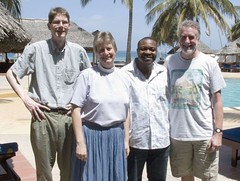
The progressive gang
The Rev. Scott Gunn, Integrity's President, the Rev.
Dr. Caroline Hall, Davis Mac-Iyalla (Changing
Attitude: Nigeria), The Rev. Colin Coward
(Changing Attitude: UK) at the Primates' Meeting
in Tanzania in 2007

Photo Credit: Scott Gunn
Used under Creative Commons License.
Some Rights Reserved
In Uganda and Nigeria, as well as other countries with harsh penalties for homosexuality (many of which are vestiges of British colonial rule), these bills seriously threaten health services providing HIV treatment to MSMs (men who have sex with men).

What can we do? Educate ourselves. Get the word out: these developments, especially those in Nigeria, have largely gone under the radar of the U.S. media. A good source of information is on the Nigerian LGBTIs in Diaspora web-site: http://nigerianlgbtindiaspora.wordpress.com/

As an Episcopalians / Anglicans we can urge our bishops to speak out. Find out who the Indaba partners of your diocese are and ask your bishop to speak with them about this; ask him or her to contact the Presiding Bishop and the Archbishop of Canterbury. Sign Nigerian LGBT rights activist Davis Mac-Iyalla’s petition to the Archbishops of Canterbury and York which can be found here.  At press time the petition was approaching 1,000 signatures.

As a U.S. citizen, you can contact your Senators and Representatives in Congress and ask them to contact the State Department, which -- although it has publicly condemned these laws -- could do more. It has been reported that the Canadian government has already cancelled a state visit by Nigerian President Jonathan which was scheduled to take place in February. Keep the pressure on.

Keep our brothers and sisters in your prayers and those of your local parish.

"No one is free until we all are." We still have a long road to travel.

Paul Lane is the Diocesan Organizer for New York and Acting Chair of the LGBT Concerns Committee of the Diocese of New York


Saturday, April 14, 2007

Africa and homosexuality

In denial
Apr 12th 2007
NAIROBI
From The Economist print edition

Anglican divisions are a reminder that homophobia in Africa is still the norm

In a nice twist of missionary history, several of America's oldest and richest Anglican parishes now claim to be under the authority of African bishops. The issue that has led them to renounce their own national leadership is homosexuality; some of the minority of Anglicans (or Episcopalians) who object to gay bishops in American dioceses are aligning with conservatives in Africa. The most influential is Archbishop Peter Akinola, who leads the 17m-strong Anglican church in Nigeria, as well as his new congregants in Virginia. His hostility to homosexuality may reflect mainstream African opinion, but he is pragmatic too. His conservative reading of the Bible helps protect his Anglican flank against the fast-growing Pentecostalists. It also seeks common ground with Nigeria's homophobic Muslims.

snip

Africa's Anglican clergymen get little education in sexuality. Some preach abstinence yet turn a blind eye to polygamous marriages, adultery and genital mutilation. Christopher Senyonjo, a retired Anglican bishop in Uganda, is one of only a small number of African Anglicans who challenge the conservatives. The hounding of homosexuals, he says, is the "opposite of Christlike".

snip

Only South Africa's Anglicans, who played a big part in combating apartheid, offer some sort of counterbalance. The church there has spoken up for homosexual rights. The government has legalised same-sex marriage. But campaigners say that South African lesbians are now being targeted by homophobic men—and sometimes even gang-raped.

Click here to read the rest.

Thursday, March 22, 2007

IGLHRC | Off the Map

Off the Map explores the ways in which HIV/AIDS stakeholders are denying a basic set of human rights to same-sex practicing people in Africa and potentially jeopardizing overall efforts to combat the AIDS epidemic. The report examines the ways in which same-sex desire and behavior have been simultaneously erased and criminalized in Africa and looks at the small, but important body of knowledge regarding same-sex transmission of HIV on the continent. The report shows that same-sex practicing men and women are at increased risk of contracting HIV not solely because of bio-sexual vulnerabilities, but as a result of an interlocking set of human rights violations that prevent access to effective HIV prevention, voluntary counseling and testing, treatment, and care. IGLHRC offers a set of detailed recommendations for African governments, foreign donors, international private voluntary organizations, and domestic AIDS service organizations designed to assist HIV/AIDS prevention and mitigation efforts among same-sex practicing people as well as in the broader community.

Click here to read the full report.