Wednesday, May 8, 2013

The Rev. Dr. Caroline Hall: Whom, Then, Shall We Hate?

 The following is the text of the sermon offered by Integrity's president, the Rev. Dr. Caroline Hall, at Christ Church in Poughkeepsie, N.Y., on Sunday, April 28th.

THE FIFTH SUNDAY IN EASTERTIDE


What wonderful readings we have today – the vision of a New Jerusalem – a new way of living - where Jesus’ words, “I give you a new commandment, that you love one another” are fully lived out. And the reading from Acts which shows us what a challenge loving one another was for the early church, just as it continues to be a challenge for us today.

Humans are not very good at loving one another. In fact, some theorists have suggested that the main function of civilization is to stop us murdering each other out of envy and rage. So Jesus’ new commandment was truly revolutionary, and it’s still revolutionary two thousand years later.
When Gentiles began to be welcomed into the new community of Jesus it created problems – the religious Jews had always kept themselves carefully separate from non-Jews, but now some of them were crossing the boundary. They were breaking the traditional purity laws.

We still have purity codes today, but ours are much less conscious, in fact we usually think of them as just common sense, or the way things are. In times of social upheaval purity codes get challenged, usually accompanied by controversial debates and political battles. Interracial marriage is an example in recent memory. For a white person and a black person to marry was to offend against the purity code of the time. Similarly, gay relationships offend against the purity codes of many people today. In the last thirty years we have seen this gradually changing until today a majority of Americans support marriage for gay couples.
It has always been part of the role of religion in society to protect purity codes and to uphold social arrangements around marriage and family organizations, so it’s not surprising that the Church has struggled with these questions, just as the early church struggled with the full inclusion of Gentiles. In the reading from Acts we heard that Peter was criticized for his acceptance of Gentiles, and so he had to explain to them step by step that first God had told him to defy the purity laws, and then secondly he found that God was already blessing these people.

Our experience as Episcopalians has been similar. We have found that God has been blessing us through the ministry of gay, lesbian and transgender people – and we have gradually realized that God blesses all of us - people of different ethnicities, people of different abilities, people of different skin tones, people of different sexual orientation, of different gender identity – even, dare I say it – people of different religions.
Which leaves us in a very difficult position.

Who is there left to hate?

If there is no-one left to hate, what will politicians and media pundits do? Love and good news never sold papers. If there is no one for us to hate, no one we are willing to blame and scapegoat, then politicians will have to find an entirely new strategy for getting us to support their agendas. No longer will we be willing to demonize foreign leaders, no longer will we be willing to mobilize to try to prevent one party or another from gaining power. No longer will we be willing to put up with partisan gridlock or with policies which give more power to the already powerful and more money to the already rich. Our whole financial and political system would have to change.

Can we imagine a world without hate? It might begin to look just a little like the New Jerusalem, the city where God makes all things new…

But let us not get too carried away. Hatred is very subtle. It isn’t always in your face. In fact, very often, especially for those of us who have grown up knowing that Jesus told us to love one another, it can be very hard to get a handle on. It comes out in little ways, in jokes made at someone else’s expense; in holding grudges and nursing grievances. It turns anger at injustice into a desire for revenge on the perpetrators. It turns grief into a demand for retribution. It infiltrates our minds in such a way that it seems quite reasonable. Hatred, fueled by fear, leads quite nice people to sanction violence and even torture – provided it happens at a distance.

Hatred allows us to justify striking back when we are hurt. Which is exactly what Jesus did NOT do. When Jesus was arrested in the Garden of Gethsemane he didn’t strike back. When he was in front of Pilate he didn’t cooperate but he didn’t resist violently. In fact, Jesus was the model of non-violent resistance. And he went one step further… he didn’t just avoid violence, Jesus forgave those who betrayed him, those who persecuted him, those who killed him.
Jesus and hate simply do not belong in the same sentence.

As disciples of Jesus, we get to obey his commandment to love, and that means we have to forgive and to do that we have to give up our habit of hatred.

It’s not going to be easy, because our society is riddled through and through with hatred, anger and violence. It’s in our newscasts, our TV programs, our facebook posts…It’s inside our minds.
But taking up love and giving up hatred is what it really means to be an inclusive church.
Inclusive sounds warm and wonderful but that’s only part of the picture. If we are to be truly inclusive, if we are to build the reign of God on earth, if we are to follow Jesus then we have to find a way to change, and to change radically. Which means hard, careful work. It means examining the way we do things to make sure that we are not leaving groups of people out in the cold, that we are not disempowering someone else in order to empower ourselves. It means welcoming people who really are different from us.

It’s not going to be comfortable. If you think being an inclusive church is going to be church just like it’s always been but with more people, then you need to think again. Because those people whom God blesses just like she blesses you, may want to sit in your seat; they may want to change the hymns; they may even, heaven forbid, decide to change the prayer book.

The early church wasn’t at all sure that they wanted to include Gentiles and the debate went on for quite a while -  just like the Episcopal church today still isn’t quite sure that it wants to include women, latinos, gays, lesbians, African-Americans, Cubans, bisexual people, transpeople, deaf people… I could go on and on.

But if we take Jesus’ words seriously, “I give you a new commandment, that you love one another. Just as I have loved you, you also should love one another. By this everyone will know that you are my disciples, if you have love for one another.” If we get serious about being Jesus’ disciples; if we get serious about replacing hate with loving and forgiving, then we will be doing more than creating an inclusive church, we will be building the new Jerusalem.

“And the home of God will be among mortals. He will dwell with them as their God; they will be his peoples, and God herself will be with them; she will wipe every tear from their eyes.”

Thursday, May 2, 2013

The Rev. Dr. Caroline Hall: Come Out Again

The following is a sermon preached by the Rev. Dr. Caroline Hall at a Taizé service at the Cathedral of the Incarnation in Baltimore, MD, on the Feast of St. Mark, Thursday, April 25th, 2013.  Dr. Hall is currently touring the Northeast to spend time with Integrity members and congregations.

The leaders of the Jewish people were trying to push Jesus into a damning admission which would give them the opportunity to accuse him of a major crime. They wanted him to declare that he was the Messiah so that they could shout treason and get rid of him. Not only was Jesus was a threat to their authority among the Jews, but his ideas might make trouble for them with the Roman authorities. They didn’t want the boat rocked.

Cathedral of the Incarnation
Cathedral Church of the Incarnation, Baltimore
Photo credit: Monument City
Yet in typical fashion, Jesus does not give them the answer they want. He says instead “The works that I do in my Father’s name testify to me.” It’s a familiar idea in Jesus’ teaching – don’t just listen to what people say but look at what they do, at how they live their lives – are they becoming more holy, more just, more compassionate or not? Jesus’ flock are the ones who are listening - those who are taking his teaching and his example and are using them to make the reign of God a reality in their lives and in the lives of the community around them.

Each one of us is called to be part of the flock. Each one of us is called to testify to the power of Jesus’ love in our lives by the way that we live. And we are being watched. Just as Jesus was watched, so we his followers are watched.

I think that’s especially true for those of us who are lesbian, gay transgender or bisexual, or those who are under thirty-five. It used to be that it was really hard to come out in the church – now for many of us it’s harder to come out to our friends and acquaintances outside the church. We are all being watched – and more often than not, the church is being found wanting.

People say they don’t want to be part of institutional religion because of the hypocrisy – and there is plenty of that. I understand that Edward Peters, a Catholic leader, recently said that Catholics who support same-gender marriage should not try to receive communion and if they do so, it should be denied them. This is just one more example of the kind of behavior that is getting a lot of media attention and is driving people away from our churches. We know that’s not what Episcopalians think, but most folk don’t make distinctions between one church and another but lump us all together in their minds.

Which means that we have to be even more aware of doing works which “testify to the Father.” The things we do are probably not going to be things that land us on the front page of the Washington Post, they’re more likely to be quiet actions of love and kindness, which grow out of a deep spiritual connection with our Abba. They’re more likely to be things which don’t stand out but which contribute to the deep well-being of our world.

And in the strange world of our God they’ll prove to be more important than the bold statements that make the headlines. God did not choose to incarnate in Rome, at the center of the Empire. God did not choose to incarnate in a wealthy, prominent family. No, God chose to incarnate in a small nation which has always been at the center of international trouble, to a small unconventional family in a small town huddled in a barn. God did not choose a flashy well-understood act to redeem the world, but instead allowed Godself to get killed in an ignominious way which no-one really understands, even to this day. And when Jesus was resurrected it wasn’t in front of crowds of people, it wasn’t in the Sanhedrin or Pilate’s palace, rather he appeared to his disciples in ones and twos and small groups.

So never let us imagine that small things don’t make a difference. In God’s kingdom it’s the small things that have the greatest impact. Sometimes we can see that they do, but more often their results are hidden.

Fifteen years ago the idea that gay or lesbian couples could ever be legally married was almost laughable. But today it’s becoming almost commonplace. We have just seen France legalize gay marriage; there’s a bill in the British Parliament as we speak; Rhode Island is on its way to becoming the 10th state to legalize gay marriage and the Supreme Court is considering the question. Moreover, the majority of Americans now think it’s ok. How far we have come in just a short time. There are many things that fed into that astonishingly rapid change, but the most important is the quiet witness of gay and lesbian people coming out to their friends, and coming out in their workplaces, and coming out in their churches.

We still need to come out today. But this time we’re not coming out as gay but coming out as Christian. Just as we had to battle public prejudice when we came out as gay, today we have to battle public prejudice as we admit that we too are Christian. And just as we had to tell people that we’re gay so we need to tell people that we follow the God who loves all people equally, even the homophobes – it’s not enough to hope that they’ll pick up the hints, that they’ll follow the clues and draw the right conclusions – we have to take our courage in our hands and testify to the Father.

What has made the difference for gays, lesbians and transgender people is that as we have come out the fantasy of the evil homosexual who is out to take your children and your marriage away has had to abate. It’s not gone altogether but it is less and less possible to maintain as more and more people know gay or lesbian people and know that they like and respect them.

It’s time now for all of us who hear Jesus and follow him to do the same thing for the image of the Christian as judgmental and limiting. It’s time for us to be seen to live lives that are joyful and generously open-hearted. It’s time for us to make sure that in everything we do we are glorifying God. It’s time for us to testify to the Father by our lives but no less by our words.
Each one of us influences a small group of people a lot and a lot of people a little, just like Jesus influenced the disciples a lot and the Jewish people a little. It’s time to use the influence that we have. It’s time to show that we belong to Jesus’ flock by testifying to the Father in our conversations as well as our lives.

It’s time for us, gay straight or neither to dare to come out as Christian!

Wednesday, April 24, 2013

Integrity President Caroline Hall Visits Philadelphia

On Sunday, April 21st, Integrity's President, the Rev. Dr. Caroline Hall, began her East Coast tour by preaching at the patronal feast of the Memorial Church of the Good Shepherd in northern Philadelphia.

The text of her sermon follows:
The Rev. Dr. Caroline Hall
I love the image of the good shepherd. It is deeply comforting to think that God cares for you and for me as intimately as a Middle Eastern shepherd cared for his sheep. Jesus says that those of us who are enrolled in his reign - those of us who are like his sheep - hear his voice and follow him. That’s a sweet image.
But there are downsides to being a sheep. As well as ticks and fleas and burrs and the smell of raw lanoline, there are… the other sheep. Biblical sheep always live in flocks – you’ll remember Jesus talked about the good shepherd leaving the ninety-nine sheep in the flock to fend for themselves while he searched for and brought back the one who was missing. You don’t get much alone time if you’re a sheep.
I grew up in the flock. My particular fold was a small Anglo-Catholic parish in the Church of England. Then I went away to college and at college I found out things about myself that made me think there was no place for me among the faithful. I found that I was gay, and though for many years I prayed and studied and prayed some more, God did not choose to make me heterosexual. So I stayed away. I stayed away for over a decade. I continued to hear God’s voice - the good shepherd did not let me go. But I was sure that I would never be welcome in the flock again – that somehow, however discreet I was, that I would smell different and they would sniff me out. Sometimes I went to church, sitting at the back, close to the exit. But I always left quickly, afraid to get involved.

I am glad to say that, in most parts of this country, things are very different now. We have realized that for decades good and godly Episcopalians have been lesbian, gay, bisexual, and transgender and that that has not stopped the good shepherd calling them and using them in powerful ministry. The courage of those who have stepped forward and said "Yes I’m gay" or "My loved one is gay and that’s okay with me and with God" has led to tremendous change in this Episcopal Church of ours. I am not afraid to tell you that God has called me to be in committed relationship with another woman for over twenty years. I am not afraid that I will be cast out of the flock.

But I am one of the lucky ones.

In fact, there are sheep in other folds who have megaphones which broadcast the idea that God loves everyone as long as they look and act like straight white people. They have done such a good job getting their message across that ours isn’t getting heard.

There are still many, many gay, lesbian, bisexual and transgender people who don’t really believe that there’s a place for them in the flock. They may hear the good shepherd calling them but they’re not about to come out of hiding because they don’t think the other sheep will like them, let alone love them. It’s easy for us to say "I wonder why we don’t see more gay people, more poor people, more immigrant people, more disabled people, when we’d welcome them just like we welcome each other." It’s easy for us to say that, safe within the fold. But they can’t hear us. We’re not making enough noise. We’re not making it clear that God loves everyone, no exceptions and so do we!

One of the problems is the noise that goes on in the heads of many gay, lesbian, bisexual and trans people. I know that Jon has told you that today is the launch of a short tour during which I am visiting churches and groups in the north-east to talk about the work of Integrity, the gay. lesbian, bisexual and trangender ministry in the Episcopal Church, and to introduce my new book, The Thorn in the Flesh. One of the reasons that I undertook the research and wrote the book is that I needed to quieten the voices in my own head. Even after ten years in the Episcopal Church, even after being ordained as a priest, there were still times when the idea that God didn’t really like me that way I am became a deafening sound. At those times, I thought that maybe those people who say that being gay and living in a loving relationship is against God’s will were right.

By taking a close look at what has happened since Louie Crew first started a newsletter called Integrity Forum for gay Episcopalians in 1974; by carefully charting the to and fro of argument and persuasion, the political ploys, the declarations of crisis and predictions of disaster, I have concluded that our church has not been engaged in a forty year theological debate about God’s reign but in trying to protect itself from the change which is happening in the whole of our society as patriarchy gradually gives way to a more egalitarian and inclusive world – what Dr. King called "the beloved community."


It’s easy for us to say, "I wonder why we don’t see more gay people, more poor people, more immigrant people, more disabled people, when we’d welcome them just like we welcome each other." It’s easy for us to say that, safe within the fold.

But they can’t hear us. We’re not making enough noise. We’re not making it clear that God loves everyone, no exceptions and so do we!
As I look around this church this morning I see people who are beloved of God. People who have been called to love and to serve in this fold. I see sheep who hear the good shepherd’s voice calling them loud and clear, and I rejoice.

But Jesus told many parables, and he made it quite clear that those who are called and who are safe in the fold have a responsibility to get out into the streets and share God’s amazing and unconditional love with those who can’t believe it’s for them. I don’t know what this looks like for you. I don’t know whom God is calling you to love for him. Perhaps there’s a house for developmentally delayed adults in your neighborhood who need people to love them for the unique humans that they are. Maybe you are being called to provide hospitality for students at the university who are a long way from home. I do know that there are thousands of gay and lesbian people living in this city who have no idea that they are welcome here. I do hope that this summer you will reach out to them during Gay Pride and let them know that the Good Shepherd is calling them too. I also hope that you will seek out ways to actively meet and serve those who are gay, lesbian and transgender and whose ability to hear has been damaged.

The Rev. Dr. Caroline Hall with the Rev. Jon Richardson,
Integrity's Vice-President for National Affairs
“Build it and they will come” is only partially true. Our welcome to all of God’s people cannot be a passive waiting with open arms but must be an active seeking out end engaging with those whom God is calling but who have no idea that there really is a place and a welcome for them. Just this week I had an email from a person wondering whether she or he would be welcome in my parish. Why? Because in private he likes to dress as a woman. For many years he has heard the sheep with megaphones announcing that dressing like a woman is an abomination unto the Lord. He is afraid it is true, and yet he longs, she longs, to be part of the beloved community and to share God’s love with God’s people.

It is the tremendous privilege and challenge of those of us who have found a safe place within the fold to get up and go out with the shepherd as he seeks those who are lost, as he looks for those who are hiding, for those whose ears are filled with the dull roar of rejection, and then to love them and to witness to God’s amazing love for us.

For it is as each one of us allows the warmth of that love to penetrate even to the parts of ourselves that have been most damaged by rejection, by loss and by fear, that Jesus’ resurrection life bursts forth and we can truly say, "Alleluia, the Lord is Risen!"

Saturday, April 20, 2013

Integrity President Tours Northeast

Integrity President Tours Northeast

Following an April board meeting, Integrity's president, the Rev. Dr. Caroline Hall, will be staying in the northeast and mid-Atlantic states to visit Integrity chapters and supportive parishes.

Below is a listing of the events you might want to participate in.  For more information, .
  • April 21 - Preaching at 10:30am service, then lunch event at Church of the Good Shepherd, 3820 The Oak Road, Philadelphia PA
  • April 21 - 6pm Adult Education Forum at Philadelphia's Christ Church (20 North American Street), speaking about her book, A Thorn in the Flesh 
  • April 22 - HRC event discussing Rev. Hall's book at 1640 Rhode Island Ave NW in Washington DC - 6pm 
  • Apr 23 - Preaching at Noon Eucharist at Baltimore MD's Cathedral of the Incarnation, 4 East University Parkway 
  • April 24 - Book discussion at Church of the Ascension, 633 Sligo Ave., Silver Springs, MD, 6:30pm 
  • April 25 - Preaching at Taize service at Baltimore's Cathedral of the Incarnation (see above), followed by dinner and book discussion 
  • April 27 - Integrity's Believe Out Loud workshop at St. James' church in Hackettstown NJ (11am to 4pm - register here) 
  • April 28 - Preaching at 10am service at Christ Church, Poughkeepsie, NY (20 Carroll St.) 
  • April 30 - Integrity chapter event at St. Paul's in Chatham, NJ (200 Main St.), 7pm 
  • May 1 - Book signing and discussion at BGSQD Bookstore in NYC, 7pm (27 Orchard St., between Canal and Hester) 
  • May 2 - St. Luke in the Fields Adult Forum, Book Discussion (487 Hudson Street, NYC) 7pm 
  • May 8 - Boston University Discussion Group (discussion Rev. Hall's book) 7pm - 40 Prescott Street, Brookline, MA (about 3 stops from the BU Central T stop) 
  • May 9 - Book signing at Episcopal Divinity School in Cambridge MA, 2pm (check with Bookstore Emporium for exact location)

Monday, April 15, 2013

Reflections on 'An Open Letter to the Church'

Our corner of the blogosphere was abuzz last week with reposts and commentary about an open letter on a fairly-new blog called I Said I Don't Know, created by a young woman named Dannika Nash. If you haven't read it, go read it. Now, please. I'll wait here.In it, Ms. Nash has some frank words for the collective church (she doesn't say in what tradition she was raised... you can draw your own conclusions), which she warns -- in a nutshell -- if you ask me and my friends to choose between you and our LGBT friends, you will lose.
"But my generation, the generation that can smell bulls--t, especially holy bulls--t, from a mile away, will not stick around to see the church fight gay marriage against our better judgment. It’s my generation who is overwhelmingly supporting marriage equality, and Church, as a young person and as a theologian, it is not in your best interest to give them that ultimatum."
This is not, should not, be news to us. In the Pew research study of the "nones" (those people who identify with no faith tradition whatsoever). the overwhelming majority are progressive voters who believe in marriage equality. They cite religious institutions' meddling in politics and focus on rules among the main reasons for their disaffection. But here is a young person willing to single herself out and flat-out say it. I love you, church, but it's just not working for me, and here's why.

Now we know that our own denominational party line is not condemning of LGBT folk, at least at the national level. We passed numerous major pro-LGBT resolutions at our last General Convention, including the adoption of a rite to bless same-gender relationships. About two-thirds of our dioceses have agreed to use that rite in some form. In areas of the country where marriage equality is legal, every bishop with jurisdiction save one signed an amicus curae urging the Supreme Court to find for a repeal of Proposition 8 and DOMA. We have many congregations where identifying as LGBT will simply not be an issue.

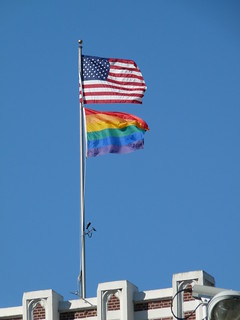
US And Pride Flags over St. Paul's: Oakland, CA
US And Pride Flags over St. Paul's: Oakland, CA,
photo by Flickr user rudisillart and shared under
Creative Commons license. Click photo for details.
However, other than at placard-and-bullhorn events, how effectively are we putting that message out there? In your town, how can you tell from the curb which church will preach tolerance from the pulpit and which will preach condemnation? When we say "all are welcome" on a website or service leaflet, do we understand that a population which has been and continues to be the target of so much vitriol from some who purport to represent Christ will -- if they don't see themselves specifically included in that welcome --  assume there's an asterisk there and a footnote in invisible ink that says "except you" ?

And can we blame them? Disconnect yourself for a minute from what you know about the inside of your own parish, your own diocesan committees, NPR and the HuffPo Religion pages, and think about what the word Christian conjures up for the average American. Does Gene Robinson get as much as much airplay as Cardinal Dolan? Whose name you think more unchurched young people know: Jim Wallace or Pat Robertson? This means that we have to try that much harder, be that much more intentional in our efforts to be known as a church where there no outcasts. We need to name those who have specifically been excluded and invite them back in the door (or -- increasingly -- for the first time) with humility and a willingness to listen.

We are -- as a denomination -- famously squeamish about touchy subjects. Garrison Keillor can get away with teasing us about it, because he's one of us (okay, and because he's Garrison Keillor!), but remember it's been said that was basically our excuse for not taking a stand on slavery, too. In my work, I've heard some amazing things done in the name of not making a scene, such as, "We stopped flying the pride flag because we want to attract more young families with kids." Really? Did you ask them first if that's why they weren't coming? Look at these numbers again, please. And -- looking again at the real picture once you're inside many of our churches -- if they have a big problem with LGBT folks, are they going to feel comfortable anyway? I doubt many of us are ready to visit the don't-ask-don't tell days. My own congregation flies a rainbow flag 24 x 7 x 365, and we're crawling with kids!

"Do we understand that a population which has been and continues to be the target of so much vitriol from some who purport to represent Christ will — if they don't see themselves specifically included in that welcome — assume there's an asterisk there and a footnote in invisible ink that says 'except you'?"
However, I get it. We don't welcome new people in a way that sends those already here screaming for the exits. We don't want to create a one-issue church, and I think I can speak for the vast majority of the LGBT faithful that we're not looking to have our lives be the topic of conversation week after week. In other words, we don't want to go to "the gay church" either. That isn't what this is about.

All it takes is a few small signs. We encourage congregations to develop a welcoming statement that specifically includes reference to sexual orientation and gender identity or uses the words gay, lesbian, bisexual or transgender specifically, for the reason described above. We have -- with our ecumenical partners in the Believe Out Loud movement -- created graphics which "our folks" will recognize and understand, which you can pop into the margin of your web site or bulletin. We ask that you consider linking to our chapter or organizational web sites and Facebook presence, and we link to those who have identified as working with us.

In another blog post titled "Winning Back the Nation", Ms. Nash writes:

"Another chunk of people in this nation are gay. And an even bigger chunk consists of people who love those gay people and want them to be treated like they matter. What would happen to this nation’s perception of God if the church began an overwhelming campaign to love gay people unconditionally? What if churches began LGBT missions (NOT to fix them, to love them exactly how they are) and proved to those people that they do matter to the church and to God? People are pretty good at detecting empty promises. How would this nation react to an outspoken love from the church? Some people would react with rage, I know that. I know those people personally, they live in my building. Churches have this really huge opportunity to love the kinds of people that Jesus would have loved. The outcasts, the abused, the thirsty. Win the nation, Church."

An LGBT mission? That's heady stuff, and maybe beyond many congregations, but that is also why organizations like Integrity are here to help. Maybe you will never have a parish contingent in a pride parade or a specific ministry to LGBT concerns. That is okay. But we know many of you are welcoming to us in your own way; we're just asking you to say it a little louder.

Christian Paolino is the Diocesan Organizer for Newark and the Chair of the national Stakeholders' Council of Integrity USA.

Our Prayers for Boston

The Board and Staff of IntegrityUSA extend our prayers for all those affected by the incidents unfolding in Boston.  As we write this, two people are known dead and at least 80 are being treated for injuries.

There is a good deal of confusion at the scenes of multiple explosions, with reports of additional devices being found and dismantled.  Local officials are urging people to stay indoors and not congregate in large groups in the street.  Google created a people finder if you are trying to get or share news about loved ones.  In an evening address to the nation U. S. President Barack Obama urged calm and pledged that the perpetrators would be found.

Episcopal News Service reports that seven runners from Trinity: Copley Square who were  participating in the marathon to raise funds for an anti-violence initiative were uninjured, and that the church -- which is very near the finish line and one of the explosion sites -- is undamaged.

The Right Rev. Gayle E. Harris, Bishop Suffragan of the Diocese of Massachusetts, will preside at a prayer service with Eucharist tomorrow April 16th at 12:15 p.m. at the Cathedral Church of St. Paul, 138 Tremont St., assuming security conditions permit.

The Most Rev. Katharine Jefferts Schori, Presiding Bishop, offered the following prayer:
"Gracious God, you walk with us through the valley of the shadow of death. We pray that the suffering and terrorized be surrounded by the incarnate presence of the crucified and risen one. May every human being be reminded of the precious gift of life you entered to share with us. May our hearts be pierced with compassion for those who suffer, and for those who have inflicted this violence, for your love is the only healing balm we know. May the dead be received into your enfolding arms, and may your friends show the grieving they are not alone as they walk this vale of tears. All this we pray in the name of the one who walked the road to Calvary."

The Episcopal Cafe offers the following prayer resources:

• Prayer for Victims of Terrorism
Loving God, Welcome into your arms the victims of violence and terrorism. Comfort their families and all who grieve for them. Help us in our fear and uncertainty, And bless us with the knowledge that we are secure in your love. Strengthen all those who work for peace, And may the peace the world cannot give reign in our hearts. Amen.
• A Prayer for First Responders
Blessed are you, Lord, God of mercy, who through your Son gave us a marvelous example of charity and the great commandment of love for one another. Send down your blessings on these your servants, who so generously devote themselves to helping others. Grant them courage when they are afraid, wisdom when they must make quick decisions, strength when they are weary, and compassion in all their work. When the alarm sounds and they are called to aid both friend and stranger, let them faithfully serve you in their neighbor. We ask this through Christ our Lord. Amen.

- adapted from the Book of Blessings, #587, by Diana Macalintal
• For the President of the United States and all in Civil Authority
O Lord our Governor, whose glory is in all the world: We commend this nation to your merciful care, that, being guided by your Providence, we may dwell secure in your peace. Grant to the President of the United States, the Governor of Massachusetts, and to all in authority, wisdom and strength to know and to do your will. Fill them with the love of truth and righteousness, and make them ever mindful of their calling to serve this people in your fear; through Jesus Christ our Lord, who lives and reigns with you and the Holy Spirit, one God, world without end. Amen.
• For Peace
Eternal God, in whose perfect kingdom no sword is drawn but the sword of righteousness, no strength known but the strength of love: So mightily spread abroad your Spirit, that all peoples may be gathered under the banner of the Prince of Peace, as children of one Father; to whom be dominion and glory, now and for ever. Amen.
• A Prayer Attributed to St. Francis
Lord, make us instruments of your peace. Where there is hatred, let us sow love; where there is injury, pardon; where there is discord, union; where there is doubt, faith; where there is despair, hope; where there is darkness, light; where there is sadness, joy. Grant that we may not so much seek to be consoled as to console; to be understood as to understand; to be loved as to love. For it is in giving that we receive; it is in pardoning that we are pardoned; and it is in dying that we are born to eternal life. Amen.
• A Hymn


Thursday, April 4, 2013

Mary Ray Worley: Personal Connections and Transformations

I was pleasantly surprised this week to read about Senator Rob Portman's change of heart regarding gay marriage. A few comments I read expressed regret that it required a personal connection—Portman's son is gay—for him to reevaluate his position. But I contend that nearly all of our best and most important transformations are prompted by personal connections. What was once theoretical becomes immediately, achingly personal, powerful enough to blast through our preconceived, long-held beliefs. We can all be glad that Portman was willing to let his personal connection to his son change his beliefs. Many of us know of parents who are unmoved and unsupportive when their children come out. Thank God for those who do better.

Few people are able to effect such metamorphoses only on a theoretical basis. It's a big reason why the personal really is political. And it's why, with fewer and fewer gay people staying in the closet, more and more of us are being transformed by those personal connections, to the extent that marriage equality is indeed beginning to look inevitable. These days we all have friends, cousins, brothers, sisters, fathers, mothers, mentors, and heroes who are gay. If your heart is open to them, then it is necessarily open to marriage equality and justice. Such is the nature of the personal connection.


"Our calling is not to cross boundaries,
defy restrictions, or escape compartments.
 It is to embrace a universe
that does not admit their existence."

"Our Calling," artwork and quotation
by Ricardo Levins Morales.
For example, when I was younger, I was an enthusiastic evangelical Christian (whereas nowadays I'm a mild-mannered, unassuming Episcopalian). I believed that homosexuality was wrong for the simple reason that people I loved and trusted told me it was wrong, and I didn't have any better information than that. One of my very best friends also believed what we were told; only for him, it was anything but theoretical. Because he was gay.

I met Patrick in high school when we were on the newspaper staff together. I went to the same university Patrick did, and seeing as how he was a year ahead of me, he took some pleasure in showing me around the big U. We did the obligatory bar-hopping tour, and he introduced me to the very exciting if somewhat daunting Plato system—my very first encounter with a computer! He was brilliant and funny and always kind. He studied Hebrew, Greek, Japanese, Russian, and Arabic just because he enjoyed learning them. He learned American Sign Language and rode a unicycle all over campus. I affectionately called him Petruchio (the romantic lead in The Taming of the Shrew). He was my very best friend from 1974 until he died at the tender age of 32 in 1987.

When I had a religious conversion experience in December of my freshman year (1974), I took Patrick along for the ride. He came to church with me and joined the same Christian group on campus. We had known each other—very well, I thought—for maybe eight years before he told me about his sexual conundrum: he was attracted to men. I was shocked. No one had ever come out to me before. It was totally outside my sphere of experience or understanding. Still, neither of us questioned what we had been taught.
"Our Spirit" is an organization which
provides LGBT youth with affirming
faith-based messaging via web video.
Click the image for more information.

Patrick struggled mightily to resist temptation, and he despised himself because he wasn't able to change. I will never forget him dissolving in anguished tears on my couch. His "failures" consisted of loveless, anonymous sexual encounters, after which he would castigate himself and resolve to do better. It was a nasty, vicious cycle of torment and self-loathing. Only a few months before he contracted HIV, Patrick said how lucky he was not to have come down with some dread disease. Obviously, his luck didn't hold.

Patrick moved to Texas a few years before he died. The first time I went to visit him there we were both struck by how nice it was to be with someone with whom we didn't even have to finish our sentences to be understood. Then he told me about his diagnosis. Back in those days, HIV was a swift death sentence. I went to Texas to visit him twice before he died.

The first time I saw him after he was diagnosed with AIDS, I was stunned by his appearance. He looked like a concentration camp survivor. For the first half hour or so I was with him, I found it difficult to breathe, as though I'd been struck on the back and had the wind knocked out of me. The change in him was so hard to process. While others shunned him, feared contagion, and worried about sharing a salad with him (I kid you not!), I cooked enormous amounts of food for him because I noticed that no matter how much I put in front of him, he ate half. I cleaned his bathroom and organized his cornucopia of prescription drugs. I never considered doing anything less. This was my Petruchio. What else could I have done?

I read as much about AIDS as I could get my hands on (most notably, And the Band Played On, by Randy Shilts) in the vain hope that understanding what was happening to Patrick would help me cope. I ran interference between him and his mother. When he lapsed into a coma during the last month of his life, I insisted that his mother hold the phone up to his ear for ten minutes every day so that I could prattle at him, whether he could actually hear me or not. Finally, I picked out where he would be buried and made arrangements for his funeral (the first funeral home I called didn't want to handle someone who had died of AIDS).

Patrick died on July 12, 1987. For years afterward I was furious with God, not because Patrick had died but because he died what seemed to me to be a small, miserable little death. He was in denial about his impending death right up to the end. He never faced himself or his disease. But to me he was so precious, so beautiful, so extraordinary. He deserved so much better. I know now, too, that I was uncomfortable with Patrick's rejection of his gayness, even though I wasn't ready to fully accept it either.

During that time, I began experiencing what is sometimes referred to as cognitive dissonance—my experiences didn't jibe with my beliefs. I talked to some friends who were gay and asked them obnoxious, personal questions like "Do you still consider yourself a Christian?" and "When did you realize you were gay? What made you think that?" I knew a lesbian couple whom I loved very much (still "hating the sin while loving the sinner"). I realized one day that I liked them very much as a couple, and I couldn't imagine them in relationship with anyone else. Gender didn't really even seem to come into it. They were just right for each other.

"Inclusiveness" Window,
McKinley Presbyterian Church,
Champaign, Illinois

The "Inclusiveness" Window at
McKinley Presbyterian Church
,
Champaign, Illinois, was
installed in 1997 in honor of my
late mother-in-law, Carolyn
Juergensmeyer Worley, longtime
member of McKinley's Social
Action Committee and a
woman with as kind, generous,
and accepting a heart as anyone
I've ever known.

To our knowledge, this is the only
stained glass window devoted to
inclusiveness as a theme in America.
Symbols abound and the most
dramatic is at the top. A pink
triangle set against a white Celtic
cross recalls the suffering and
repression of GLBT persons at the
hands of the Nazis in Germany in the
30’s and 40’s. Also included are
the rainbow flag, an AIDS ribbon,
and male and female hands
clasping one another and supported by the
hand of God.
In 1991, I moved to Madison, where I began attending an Episcopal church, still pretty mad at God and still confused. There I met Clay, who was our choir director. I learned not long after I met him that Clay was married to his partner, John. When I went to their home, I looked through their wedding album. It was oh-so-ordinary. And lovely. I finally thought to myself, "Well, maybe in an ideal world, people wouldn't be gay. But since when was this ever an ideal world?" I was still processing, still questioning, and not quite ready to fully embrace and celebrate "the gay," but no longer willing to judge or reject just because I was taught to.

I found myself wishing with all my heart that Patrick could have been able to enjoy what Clay and John had: a loving, committed, fulfilling relationship. How vastly better than furtive, anonymous, life-threatening sexual encounters followed by weeks of self-loathing and unremitting remorse. I loved being with Clay and John, because I found their love healing and comforting. I let go of the last of my reservations in the shelter of their love for me and for each other.

In 1997 Clay started Perfect Harmony, Madison's gay and gay-friendly men's chorus. I got to sing the part of Dorothy for "Over the Rainbow" in their very first performance. Imagine being the only woman singing with a chorus of 25 men. It was glorious! At many of the Perfect Harmony concerts for several years after that I got to sing either solos or ensembles with the men. It was thrilling. One year I sang "Have Yourself a Merry Little Christmas" and leaned a little extra on the line "Make the Yuletide — gay," to the audience's delight. Clay said to me at one point, "You know, most of the audience probably thinks you're gay." The thought hadn't occurred to me. I paused for a moment, smiled, and said, "Cool! I'm honored." I think you could say that by then my transformation was pretty well complete.

As it happened, Clay also had AIDS, only by that time treatments were much better, so he lived with his disease for ten years (instead of Patrick's ten months) before he died. And John, Clay's husband, was a nurse, so Clay was very well cared for during his illness. I got to visit him the day before he died. "You're going to die too, you know," he said to me. I assured him that I knew. He also told me he'd look up my friend Patrick when he got there, wherever "there" is. I still love the thought of them meeting each other.

The day before he died, it seemed like the veil was already disintegrating for Clay and he could see well beyond it. He faced his death with courage and even joy, ready for whatever came next. His funeral was one of the most beautiful church services I've ever been to. Because he had picked out all the hymns and the readings, his presence was palpable. I felt so close to him. His was a good, courageous death, unsullied by self-loathing and recriminations. It was the perfect counterpoint to all that had distressed me so deeply about Patrick's death.

I'm no longer angry at God. I celebrate both Patrick's life and Clay's. I'm grateful that God made them exactly as they were. Had they not been gay, they would not have been themselves. And who they were is one of the greatest gifts God has given me. I have been enriched beyond measure by knowing and loving them. And I'm so grateful there was more to the story of "the gay" than what I was first taught. I have had the remarkable experience of personal connection, transformation, and love. I wish Senator Portman—and his son—much joy as they navigate the experience of connection and transformation together.

Mary Ray Worley is freelance copy editor and a member of Grace Episcopal Church in Madison, Wis., where she leads the music at the noonday Spanish service. She blogs at http://worleydervish.blogspot.com, where this was originally published.

--

Integrity encourages the use of personal narrative like Mary's to gracefully engage those who are struggling with the concept of LGBT inclusion in the church.  We offer workshops across the country to equip individuals and congregations to do this work.

Tuesday, April 2, 2013

Coverage of Marriage Rallies in DC & Beyond

Rally at L.A. City Hall: (L to R)
Lori Kizzia, Diocesan Organizer Jim White,
Randy Kimmler, The Rev. Susan Russell
Last week, Integrity encouraged its members to participate in the "Light the Way to Justice" events which were taking place as the Supreme Court considered cases involving both California's Proposition 8 and the "Defense of Marriage Act."

From Los Angeles to Virginia Beach, our members took part in rallies as elected officials, activists and people of faith spoke about the importance of having our relationships recognized.

The timing was both hugely inconvenient and profoundly significant for religious leaders as the hearings fell squarely in the middle of the busiest and most important week in the Christian calendar, as well as during Passover.  Integrity's former president, the Rev. Canon Susan Russell, wrote in the Huffington Post:
I'll admit my first reaction to the announcement that the arguments had been scheduled for March 26 & 27 was an incredulous "Seriously?" And yet as the clock has ticked down to Holy Week, it has become clear to me that the preparation happening for the work in the halls of justice is just as holy as the preparation happening in the halls of worship. I have come to see a profound synchronicity between a core value I hold as an American -- "liberty and justice for all" -- and a core value I hold as a Christian -- "love your neighbor as yourself." And I have been deeply gratified by the number of people of faith standing up and speaking out for equality -- not in spite of their faith but because of it.
She attended and spoke at a candlelight vigil on the evening of Sunday, March 24th on the steps of Los Angeles City Hall, along with Integrity Diocesan Organizer Jim White and others from All Saints: Pasadena.

The Right Rev. Gene Robinson, retired Bishop of New Hampshire, also pondered what conclusions could be drawn from this religious and judicial overlap in a guest column in the Washington Post.
"It was not lost on this person of faith that the Supreme Court hearings on marriage equality took place during the season of Passover for Jews and Holy Week for Christians. Was it coincidence, providence or simply God’s divine sense of humor, that these hearings would overlap with the greatest story of oppression-to-freedom ever told, reenacted at every Seder table? Would the justices find any connection between the Holy Week/Maundy Thursday edict from Jesus to “love one another” and the pleas for justice and respect from LGBT citizens? Time will tell."
Bishop Robinson attended the events in Washington D.C., which included both an interfaith prayer service and a themed seder in a nod to the number of people of faith who were taking part.

The Believe Out Loud crew in D.C.
Joseph Ward, James Rowe, Alison Amyx & Leigh-Anne Borkowski

A child shall lead them: 9-year-old
Leo talks marriage equality in D.C.
Joseph Ward, Director of the Believe Out Loud campaign and his team, also attended the D.C. rallies.
"I cautiously entered Holy Week knowing and feeling the mood of America changing, but it was overwhelming to see it confirmed in many ways by so many loving people in and outside of Washington, D.C."
Joseph wrote in a Huffington Post column that he was struck by the testimony of Leo, a 9-year-old boy whose two mothers are unable to get married:
"We cheered him on as he talked and read passionately about his support and love for his mothers. As he left the stage he yelled excitedly, 'Mom, I was the youngest speaker!' He walked past and I told him he did a great job to which he smiled and said, 'Thank you!' It was moving to hear Leo speak out for his mothers and gay people like myself."
U.S. Supreme Court Justice Anthony Kennedy expressed concern during the Proposition 8 hearings about the effect of the current inequality on the children of same-sex parents, an estimated 40,000 of them in California alone:
"There is an immediate legal injury and that's the voice of these children... that live with same-sex parents, and they want their parents to have full recognition and full status. The voice of those children is important in this case, don't you think?"

Province III Coordinator Susan Pederson and members of
Integrity Virginia Beach at a rally in Norfolk, Va.

Members of Integrity Virginia Beach including Province III Coordinator Susan Pederson attended a rally on the steps of the Walter E. Hoffman Federal Courthouse in downtown Norfolk, Va., on Tuesday March 26th, organized by the Rev. Mark Byrd of the New Life Metropolitan Community Church. 

"The possibility of rain kept some of our friends from coming to the rally but there were folks there from many different faith groups," Pederson reported. "We had a good crowd and the reception by the folks passing on the street was positive. We stood together as one in prayer for marriage equality."


The Rev. Scott Allen and Dixie Dugan White, co-founders of
Integrity Bethlehem, at a rally in Allentown, Pa.
The co-founders of Integrity Bethlehem, the Rev. T. Scott Allen and Dixie Dugan White, were part of an event on Saturday, March 23rd at the Edward N. Cahn Federal Courthouse in Allentown, Pa., which was organized by the Pennsylvania Diversity Network. Since the courthouse is on the Main Street of Allentown and very busy, many people slowed down and honked and gave the thumbs-up sign to the 100 or so gathered there. Speakers included City Council representatives from Allentown and Bethlehem, Labor Union Activists (Teacher's Union), local LGBT activists and a keynote from a woman who described the disadvantages she encountered while settling her late partner's estate.

"It was a cold day with a fairly brisk constant breeze which made it feel much colder!" recalled Allen, "But the people gathered there sang 'This Land is Your Land' and 'Going to the Chapel' with heart and energy! It was a diverse group with straight allies and LGBT from many walks of life present."

Randall Abbott and his partner Jerrod, Integrity life members who attend the Cathedral Church of St. Paul in Springfield, Ill., were invited by the Rev. Martin Woulfe of the Abraham Lincoln Unitarian Universalist Congregation to a silent witness and sidewalk prayer vigil at Paul Findley Federal Plaza in that city, the state's capitol on March 25th.  "We were surprised at the number of horn honkers supporting us, including a Springfield police cruiser, a USPS truck, and several State of Illinois vehicles," Abbott reported.  "I estimated that about half of the passing vehicles did honk to support marriage equality on a cold, blustery day in downstate Illinois."

Abbott described the experience as "particularly gratifying" since the Bishop of Springfield, the Right Rev. Dan Martins, has stated he will not permit the recently-adopted rite for blessings of same-sex relationships to be performed in the diocese. On the other side of the state and the issue is the Bishop of  Chicago, the Right Rev. Jeffrey D. Lee, who has spoken out strongly for marriage equality. The Illinois Senate passed a marriage equality bill on Valentine's Day, and the House will take it up before May 31st.  The measure has the backing of governor Joseph "Pat" Quinn II.  

Students, a P-FLAG chapter and others attend a rally on the
campus of Montclair State University in New Jersey
Pride flags on display at St. Stephen's Church
on the campus of Ohio State University
In New Jersey, Integrity Stakeholders' Council Chair Christian Paolino joined a rally organized by student groups on the campus of Montclair State University on Wednesday afternoon.  Members of the North Jersey chapter of P-FLAG were also in attendance.  Among the speakers was State Senator Ray Lesniak (D - Union), who is sponsoring a bill in the state legislature banning "reparative therapy" on LGBT young people.   Senator Lesniak also published a book called What's Love Got to Do With It: Making the Case for Same-Sex Marriage during the effort to legalize marriage equality in New Jersey in 2010.  The bill, which passed in both houses, was vetoed by Governor Christie.

Meanwhile, many others across the country took part in vigils and rallies, or simply prayed that the Court be inspired towards a just and humane outcome.  At St. Stephen's Church on the campus of Ohio State University in Columbus, the Rev. David Soland reports that a petition for the Supreme Court was included in the Prayers of the People.

Rulings are not expected until June.

Were you in Washington DC or at any of the events across the country?  Please contact us with your thoughts and photos.

Sunday, March 31, 2013

Resurrection Always Comes, but at a Cost

Dear Friends:

Everywhere we look there are signs of Easter hope - the positive signs coming from the Supreme Court discussions; polls showing that increasing numbers of people support gay marriage;  more and more Believe Out Loud parishes and Proud Parish Partners; two openly gay candidates in Bishop selection processes; and news of the ministry of LGBT Anglicans in San Salvador.

The Rev. Dr. Caro Hall
Jesus’ ministry was to preach and demonstrate the reign of God where prisoners are set free, the blind see, and the lame leap for joy. I am quite convinced that if his earthly ministry were taking place today he would include LGBTQ people coming out and finding their right relationship with God and humanity. Jesus would include us because the reign of God is about becoming who we are truly made to be – as Irenaeus said, “The glory of God is the human being fully alive.” I give thanks this Easter that all over the world LGBTQ people are becoming more fully alive.

Yet Jesus’ ministry resulted in his death in shame and agony. Resurrection comes at a cost. There are many people who bear the marks of the struggle in their bodies and their psyches – including in our movement. I give thanks for those people.

Holy Week serves as a reminder that resurrection is not cheaply won. Jesus did not sail through his last mortal days always confident that he would be able to respond to degradation without retaliating, or that he would be able to bear the betrayal and pain with equanimity. Even as we celebrate the signs of new life and resurrection, we remember that it is only part of the story. Many have died in the struggle.


Even now, only nine states allow us to marry. Forty-one do not. Most Episcopal dioceses allow some form of blessing for same-gender relationships. Many do not. Although our church canons may not allow for discrimination against LGBTQ people, subtle and insidious discrimination still exists. In our society it is often not so subtle and sometimes filled with hate. In ninety-three countries it is still illegal to be gay. In seven of these it is punishable by death.There is much to be done before God’s reign is experienced by LGBTQ people the world over. Our calling is to continue to do the work, despite discouragement and set-backs. Our calling is to follow Jesus in his quest to bring all people regardless of color or sexuality or bank balance or physical ability into the reign of God. Holy Week reminds us that the work is not always easy or fun.

Easter reminds us that resurrection is the gift of God which always comes, because God is faithful. I thank you for your faithful witness to the incredible and unconditional love of God, and wish you and your beloveds a peaceful and joy-filled Easter.

With love in God’s service,

The Rev. Dr. Caroline Hall

Friday, March 29, 2013

Familial Exchange: a Good Friday Meditation


Meditations on the Seven Last Words of Jesus 
Marsh Chapel, Boston University
Good Friday, March 29, 2013


1) Father forgive them, for they know not what they do (Luke 23:34)
2) Truly, I say to you, today you will be with me i
n paradise (Luke 23:43)
3) Woman, behold your son: behold your mother (John 19:26-27)
4) My God, My God, why have you forsaken me, (Matthew 27:46 and Mark 15:34)
5) I thirst (John 19:28)
6) It is finished (John 19:30)
7) Father, into your hands I commit my spirit (Luke 23:46)

John 19: 23-27

23When the soldiers had crucified Jesus, they took his clothes and divided them into four parts, one for each soldier. They also took his tunic; now the tunic was seamless, woven in one piece from the top. 24So they said to one another, ‘Let us not tear it, but cast lots for it to see who will get it.’ This was to fulfill what the scripture says,

‘They divided my clothes among themselves,
   and for my clothing they cast lots.’

25And that is what the soldiers did.

Meanwhile, standing near the cross of Jesus were his mother, and his mother’s sister, Mary the wife of Clopas, and Mary Magdalene. 26When Jesus saw his mother and the disciple whom he loved standing beside her, he said to his mother, ‘Woman, here is your son.’ 27Then he said to the disciple, ‘Here is your mother.’ And from that hour the disciple took her into his own home.


In the midst of community we are estranged. In the midst of alienation, community is formed afresh.

The scene before us is unimaginably bleak.  An innocent man hangs before us, being stripped of life.  His loved ones look on from near and afar, nearly crushed by pain.  Yet in the midst of utter desolation, Jesus inaugurates a new creation.  A new community, a transformed family.  To his mother he says, “Woman, here is your son.”  To the beloved disciple, “here is your mother.”  “From that hour,” the gospel reports, “the disciple took her into his own home.” 

Strange as it may seem, this passage echoes the first miracle story in the Gospel of John.  Seeing a connection between this story and our passage, the sixth century Byzantine Hymnist Romanos imagined a grieving Mary querying her son, “Is there once again another wedding at Cana?”[1]   In the second chapter of John’s gospel, Jesus had declared to his mother, who was concerned about the depleted wine supply, “Woman… my hour has not yet come” (John 2:3-4).  He had gone on to transform the contents of six water jars into the finest of wines.  Now, standing in “the hour” of his death, the formation of family has become once more an occasion of transformation.  To and for his beloveds, Jesus performs a relational exchange: I now pronounce you mother and son.

In this week in which the Supreme Court oral arguments on Proposition Eight and DOMA have saturated the airwaves, the transformation of community, of family, of marriage, are much on our minds and hearts.  In a poignant column this week, a fellow Episcopal priest, the Reverend Canon Susan Russell, evoked how painful – and for LGBT people and our families, how triggering – it can be to hear these arguments.
If you find yourself hurting, angry, anxious, scared or snarky reach out and let someone you love remind you that you're loved… And if you know someone who may not reach out, find them where they are and remind them that they're loved.[2]

In this week of “heightened scrutiny,” Jesus’ words reach across the chasms of fear.  For we are family, all of us.  We are made for one another.  However fraught our communion, however intense our disagreement, however frayed our fabric, we are constantly being knit afresh. 

Like Jesus’ garment for which the soldiers cast lots, we are called to be one, mysteriously,seamlessly woven from above.  In this light, the fourth century theologian Ephrem the Syrian challenges us, “Share then, for love of [Christ], the body of him who, for the love of you, shared his garment between those who were crucifying him.”[3] This body of which we all are members: share it.  This is the message we receive at the foot of the cross, that ultimate symbol of stigma and alienation that turns death and division on its head.  This is my body.  This is your family.  Take, absorb, share it in its entirety.  Fling wide the doors of your heart.  Be transformed.

photo from
http://www.npr.org/2013/03/27/175463886/photos-supreme-court-hears-arguments-on-doma
Cameron Partridge is the Episcopal Chaplain at Boston University and a Lecturer at Harvard Divinity School


[1] Romanos the Melodist, “On the Lament of the Mother of God,” stanza 1. 
[2] Susan Russell, “The Marriage Equality Debates: The Pastoral in the Political” 
[3] Ephrem the Syrian, Commentary on the Diatessaron 20.27

Sunday, March 24, 2013

Focusing on Marriage Equality This Holy Week

Integrity is partnering with Believe Out Loud and United for Marriage in sponsoring a national effort called "Light the Way to Justice" to gain focus on marriage equality as the Supreme Court considers two cases which could dramatically affect policy and discourse in the days ahead.

The Rev. Vicki Flippin, Pastor of the Church of the Village (UMC) in New York, tells the story of Edith and Thea, a lesbian couple of over 40 years who were married in Canada. A short time later, Thea died.  Edith was saddled with an inheritance tax bill of over $300,000, which she would not owe if their marriage was legally recognized. Her case will be heard by the Supreme Court this week, and the outcome could have a dramatic outcome for the Defense of Marriage Act.  

The epicenter of this movement is, appropriately, in Washington DC.  On March 26th and 27th, a rally will take place on the steps of the Supreme Court building.  There will be opportunities to dialogue with elected officials, an interfaith prayer service on Tuesday morning and a seder on Tuesday night. More details are here.

For those unable to travel, United for Marriage has an interactive map where you can find or plan your own event across the country. 

Mary Button's LGBT Stations of the Cross
Believe Out Loud has brought the artwork series Stations of the Cross: The Struggle for LGBT Equality by Mary Button to Washington, which will be on display at the Church of the Reformation (ELCA), 212 East Capitol St.

Mary Button has given her permission for individuals or groups to use her work as a reflective or worship tool; please attribute her work if you use it.  A traditional or LGBT-perspective service of stations may be used.

Pastor Flippin, who will an interfaith rally in New York on Tuesday,  makes the case that this Holy Week, communities of faith should take a look at how we have contributed to the laws that affected Edith and Thea's life so profoundly.  She writes, "I pray that we will follow in Christ's footsteps to overturn what is wrong in our temples and work for the true and historic meaning of the Passover festival, which is LIBERATION!"